Quick Insight Into Smart Contracts
de LCX Team ·
In the ever-evolving landscape of digital innovation, blockchain technology has emerged as a game-changer, revolutionizing industries from finance to supply chain management. At the heart of this transformation lies a groundbreaking concept known as smart contracts.
Understanding Smart Contracts
A smart contract is a program that automatically executes the terms of an agreement or contract. Smart contracts are encoded and stored on the blockchain. They orchestrate agreements between the creator and recipient, thereby rendering them unchangeable and irreversible. Their primary purpose is to automate the execution of an agreement without the need for intermediaries, ensuring that all parties can instantaneously confirm the conclusion. In addition, they can be programmed to initiate a workflow in response to particular conditions.
Once all the conditions specified in the code of the smart contract are met and the necessary actions are carried out, the contract is deemed to be executed. Smart contracts, made popular by the Ethereum blockchain, have led to a variety of decentralized applications (DApps) and other use cases on the network.
Historical Background of Smart Contracts
Contrary to popular belief, smart contracts existed long before blockchain technology. While Ethereum, which was introduced in 2014, is the most prominent implementation of the protocol, Nick Szabo developed the concept of smart contracts in the 1990s. Szabo conceived of Bit Gold, a digital currency, at the time. Despite the fact that the asset was never launched, this Bitcoin (BTC) precursor highlighted the smart contract use case — trustless internet transactions.
Prior to the emergence of blockchain technology in the late 2000s, smart contracts did not receive significant attention. The development of blockchain technology enabled the creation of decentralized, trustworthy networks that did not require a central authority to execute smart contracts. Ethereum was the first distributed ledger platform to support smart contracts.
Smart contracts have advanced significantly over time. Currently, they are used in a variety of applications, including supply chain management, real estate transactions, and voting systems. Smart contracts have the potential to revolutionize how business is conducted and how people interact, and their development is an intriguing area of innovation in the blockchain space.
How Do Smart Contracts Work?
Consider smart contracts as “if-then” digital statements between two (or more) parties written in a code on the blockchain. If the requirements of one group are met, then the agreement can be honored, and the contract is deemed fulfilled. The actions are carried out by a network of computers when predetermined conditions are met and verified. This may involve releasing funds to the appropriate parties, registering a vehicle, sending out notifications, or issuing a penalty. Upon completion of the transaction, the blockchain is updated. This means that the transaction cannot be modified, and only parties with permission can view the results.
Within a smart contract, there can be as many conditions as necessary to ensure that the task will be satisfactorily completed. To establish the terms, participants must determine how transactions and their data are represented on the blockchain, agree on the “if/whenthen” rules that govern those transactions, investigate all potential exceptions, and define a dispute resolution framework. The smart contract can then be programmed by a developer, although businesses increasingly provide templates, web interfaces, and other online tools to facilitate the structuring of smart contracts.
Detailed steps for building a smart contract are:
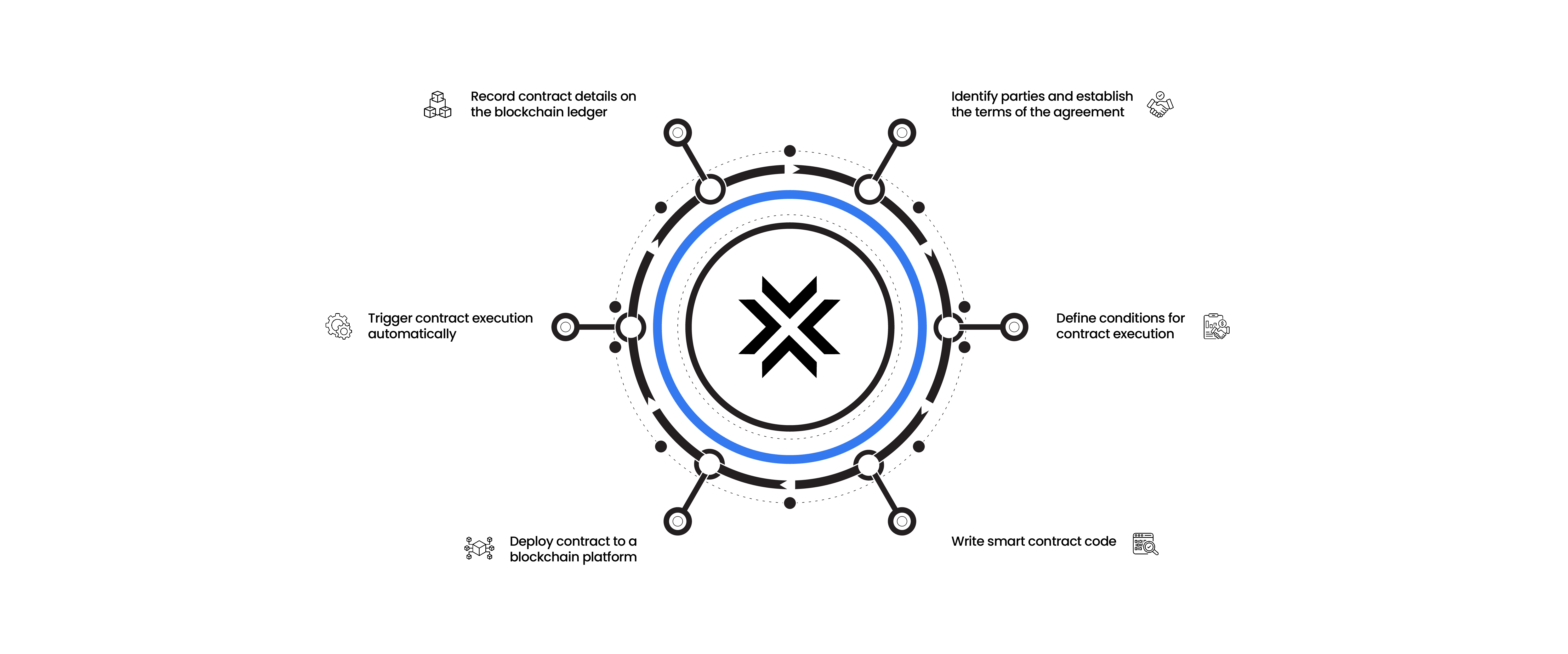
Determine the parties and the terms of the agreement:
Identifying the parties involved and agreeing on the terms and conditions of the contract is the initial step in establishing a smart contract. This agreement describes the provisions of the contract, the obligations of each party, and the standards for contract execution.
Specify the terms of contract execution:
The second stage is to stipulate the conditions for contract execution. Typically, these conditions are stated as a set of rules or criteria that must be met for the contract to be deemed genuine.
Codify the smart contract:
The third stage is to create the smart contract’s code. When the specified conditions are met, the code will specify the precise actions that must be taken to execute the contract.
Contract deployment on a blockchain platform:
The fourth step is deploying the smart contract on a blockchain platform. This involves transmitting the contract’s code to the blockchain network in order to validate its validity.
Automatically execute the contract terms:
Execution of the smart contract is the fifth phase. When the predetermined conditions are met, the contract is autonomously executed and activated by the blockchain network.
Record the contract’s specifications on the distributed ledger:
When a contract is implemented, its information is added to the blockchain network. This includes the contract’s provisions, the prerequisites for execution, and the date and time of execution. Once entered into the blockchain ledger, the contract’s details are immutable, meaning they cannot be changed or withdrawn.
Applications of Smart Contracts
Financial Services: Smart contracts facilitate automated payment processing, loan disbursement, and insurance claims, streamlining operations and reducing the risk of fraud. Decentralized finance (DeFi) platforms rely heavily on smart contracts to offer various financial services.
Supply Chain Management: Smart contracts enable end-to-end traceability, ensuring transparency and authenticity throughout the supply chain. They can automate inventory management, track product origins, and enforce compliance with regulations, improving efficiency and reducing counterfeiting.
Real Estate: Smart contracts simplify property transactions by automating tasks such as escrow management, title transfers, and rental agreements. These contracts can enhance the speed, transparency, and security of real estate transactions, reducing costs and minimizing disputes.
Intellectual Property: Smart contracts can revolutionize copyright and licensing agreements by automatically enforcing terms and ensuring fair compensation for creators. This technology enables the secure transfer of digital assets while protecting intellectual property rights.
Conclusion
Smart contracts have emerged as a transformative force within the blockchain ecosystem. By automating the execution of agreements and removing intermediaries, smart contracts increase efficiency, transparency, and trust. Their potential to revolutionize industries such as finance, supply chain management, and real estate is undeniable. As blockchain technology continues to evolve, smart contracts will play an increasingly vital role in shaping the future of business and creating a more decentralized and efficient world.