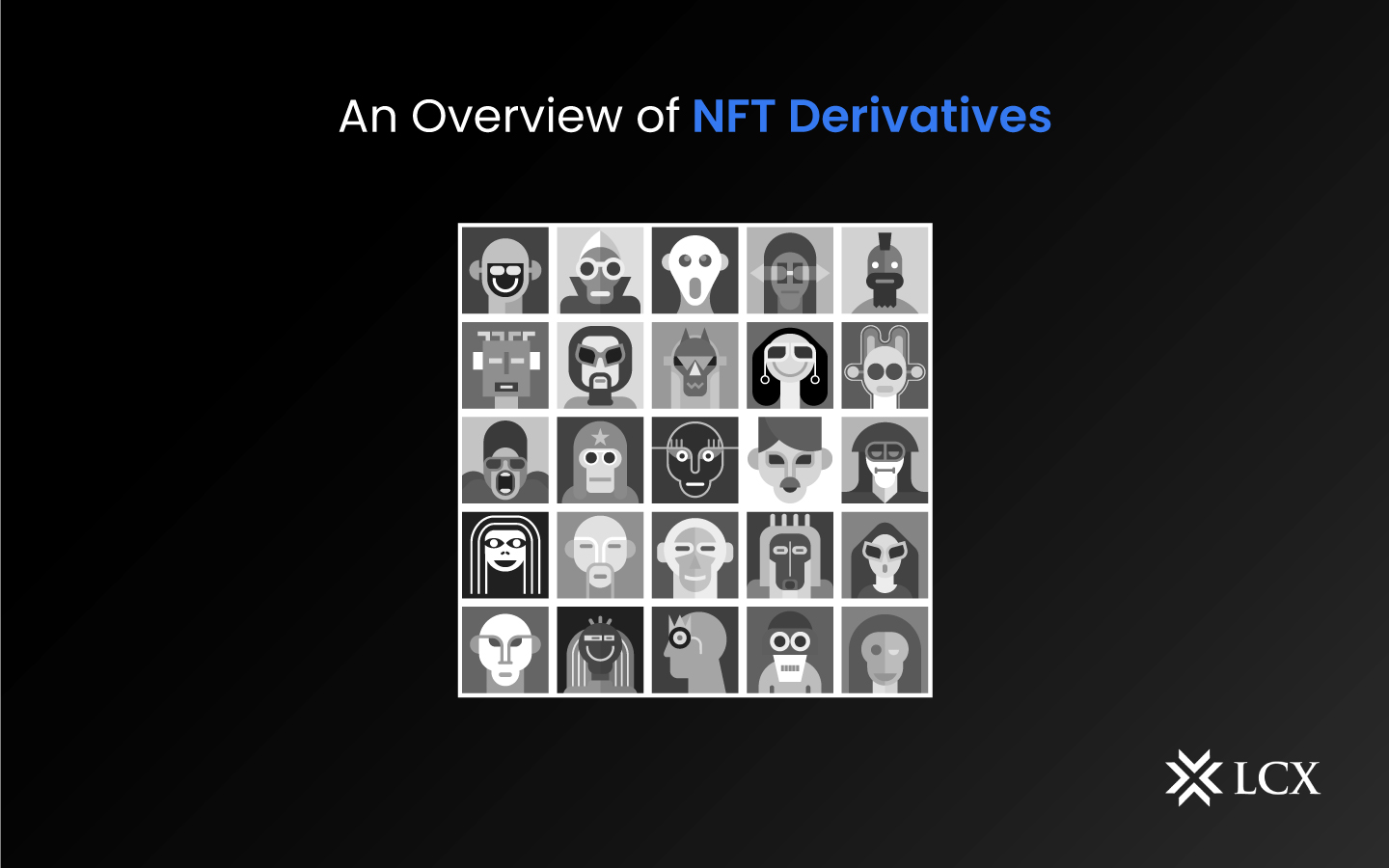
Understanding NFT Derivatives
de LCX Team · · Updated October 18, 2023
As the market for non-traditional currencies, NFTs continues to grow, a new asset class, NFT derivatives, has emerged. These instruments of finance draw their market value from the underlying NFTs, providing shareholders, creators, and enthusiasts with opportunities. They are collections of NFTs that have similarities to some widely recognized NFTs. These derivatives generally incorporate characteristics of existing projects without introducing many new ones.
NFT Derivatives Explained
NFT derivatives are collections of NFT that extract characteristics and forms from prominent NFT projects. In addition to having a striking visual similarity to the original NFT, a derivative will have a similar classification.
Renowned NFT collections, such as Bored Ape Yacht Club (BAYC) and CryptoPunks, serve as the foundational framework for numerous derivatives. A huge proportion of derivative projects use components from previous project editions without authorization from the NFT project that they are based on. Unless the original project issues an official declaration of partnership, you can infer that a derivative NFT is unauthorized.
Yet, the initiating team of a popular project can distribute an additional delivery as a spin-off. Typically, these forms of NFT collections are referred to as “legitimate derivative projects.”
Why Are Individuals Intrigued by the Development of NFT Derivatives?
The increasing popularity of NFT derivatives can be linked to the worldwide prevalence of NFTs as a new asset class. The NFT community has a mixed opinion with regard to derivative initiatives. Some view them as unoriginal imitations of extant projects, whereas others view them as a tribute to the initial collections upon which they are based.
However, digital creators can choose to come up with a derivative work for a variety of reasons. In addition, there is a distinction between an unauthorized derivative project, an affiliated derivative, and a spin-off dropped by the founding team of a project.
Types of NFT Derivatives
Fractionalized NFTs: To fractionalize a non-fungible token is to divide it into smaller, movable tokens that represent fractional ownership. This procedure enables price discovery and makes significant-value NFTs readily available to a broader audience of investors. On secondary trading platforms, fractionalized NFTs can be traded, providing liquidity and developing an ever-changing economy.
NFT Index Funds: These are portfolios of varied NFTs that represent a particular industry or theme, such as digital artwork or virtual property. NFT index funds enable investors to obtain liquidity in the wider NFT market despite having to conduct individual token research and purchases. Investors are able to purchase and sell shares of the index fund, which modifies its portfolio depending on the fund’s approach and the outcomes of the actual NFTs.
Futures and options: These are financial instruments that enable investors to make predictions on the future price of the underlying asset. In the context of these digital tokens as a new asset class, the value of specified NFTs or NFT indices may serve as the basis for these contracts. Futures and options on NFTs facilitate risk management and the development of more advanced trading strategies in the NFT market.
NFT Derivatives: Opportunity or Risk?
While the recent development of derivatives may contribute to the diversification of the NFT market, not all derivative NFTs are created equal. Others are created to demonstrate gratitude for the original work. Given the present trend towards change in the NFT market, the prices of popular NFTs continue to rise as a new asset class. As a result, it will become more difficult for average users to acquire their preferred NFTs, which will contribute to the formation of a large number of innovative NFT projects.
However, derivatives are presently in a bit of a gray area, and future regulatory policies may be required to determine the risks associated with investing in such collections. Currently, if a popular NFT derivatives project can hold its own value, has an enthusiastic community backing it, and has obtained legitimate NFT registration rights, it’s important to keep these projects in mind to grasp what the derivatives market is capable of offering.