Wall Street killed Bitcoin’s wild rallies: 10x’s Markus Thielen

Bitcoin’s days of consecutive double-digit price surges are over as Wall Street traders and profit-taking whales reshape the market, according to 10x Research founder Markus Thielen.
Institutional traders selling call options after rallies have made Bitcoin’s violent price explosions of earlier years less common, Thielen says in the latest episode of Cointelegraph’s Trade Secrets.
Thielen is also the author of Crypto Titans, a history of the industry. Writing the book led him to notice how each cycle brought different people pitching crypto to investors.
“Every cycle had actually different promoters, and different promoters bring in different investors,” he says.
This time, the promoters come from Wall Street, where investors trade on economic data and Federal Reserve decisions. Thielen says he expects Bitcoin will rise quickly on news, then spend time crab walking across the chart before the next big macro event.
Who’s really buying Bitcoin?
Thielen estimates that market makers account for up to half of the $60 billion in net spot Bitcoin ETF inflows he analyzed. Those firms hold ETF shares as a way to hedge their options trades, so the positions do not necessarily represent a bet that Bitcoin’s price will rise.
“So in the end it was not outright buying,” he says.
His estimate draws on a review of Form 13F filings, which disclose certain securities holdings of investment managers.
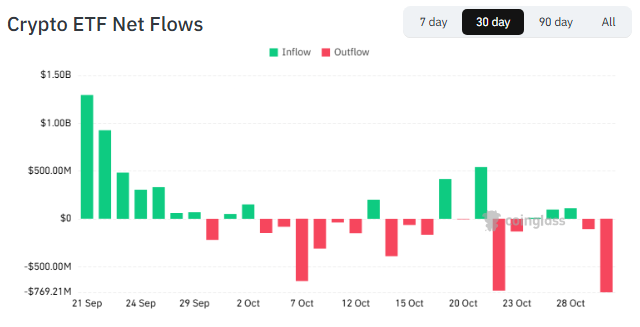
Thielen says the first wave of funds into the ETFs also included retail investors buying through institutions and corporate vehicles. Some paid substantial premiums to the value of the underlying crypto holdings.
“I would still think the institutions could come. I would still think that some of the sovereign wealth funds could come,” Thielen says.
Bitcoin could reach $90,000 by year-end
Thielen still sees Bitcoin reaching $90,000 by year-end. He says a drop into the mid-to-high $70,000s could come first.
Bitcoin has already been trading in that range, falling to about $76,100 on Friday following Binance’s $6.3 billion hack. BTC finished October down 7.3%, according to Coinglass.
Thielen compares the recovery in prices over recent months with early 2023, when Bitcoin rose from around $20,000 to $30,000. He says the doubts surrounding this year’s rebound are familiar as investors scan for the next price drop and entry point.
“I think everybody sort of missed it. So everybody wants to buy again.”
BTC’s return to $90,000 may rest partly on how much further the Fed raises borrowing rates. The central bank increased its benchmark rate by a quarter of a percentage point in September, to a target range of 3.75%–4%.
It held rates steady last Wednesday in a split vote, with two officials voting for another quarter-point increase. The Fed’s statement said inflation was still elevated, leaving open the possibility of further increases.
Thielen expects another hike by December, followed by a more cautious approach to further increases that could help Bitcoin rally toward year-end.
Ethereum needs to show holders the money
Thielen expects Bitcoin to outperform Ether, saying too much of the value from Ethereum activity goes to layer-2 networks.
“I look at it more as like a valuable utility, but nobody wants to pay for it.”
Making those networks cheaper to use has been a deliberate part of Ethereum’s development. But cheaper transactions may muddy the investment pitch for ETH.
Ethereum burns base fees paid by users, removing those coins from circulation. Its supply shrinks when the amount burned exceeds new ETH issued to validators. Lower fees can mean less ETH is destroyed.
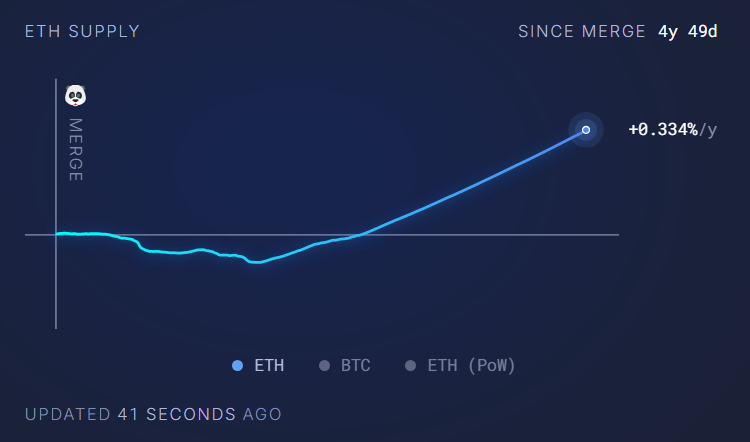
ETH supply grows when issuance exceeds the amount burned. Source: ultrasound.money
Thielen, who says he has been bearish on Ether for more than a year, compares Ethereum with a highway.
“Everybody wants the highway to be empty so you can go fast, and the roads need to be super, super clean and fixed and everything, but nobody wants to pay for it,” he says.
He singles out Hyperliquid as an example of how trading activity can fund token purchases. The decentralized perpetuals exchange’s assistance fund converts trading fees into HYPE, which is then burned.
For Ethereum, he wants a stronger connection between the network’s use and the financial benefit to holders.
Magazine: Bitcoin turns 18: Has the original rebel grown up?