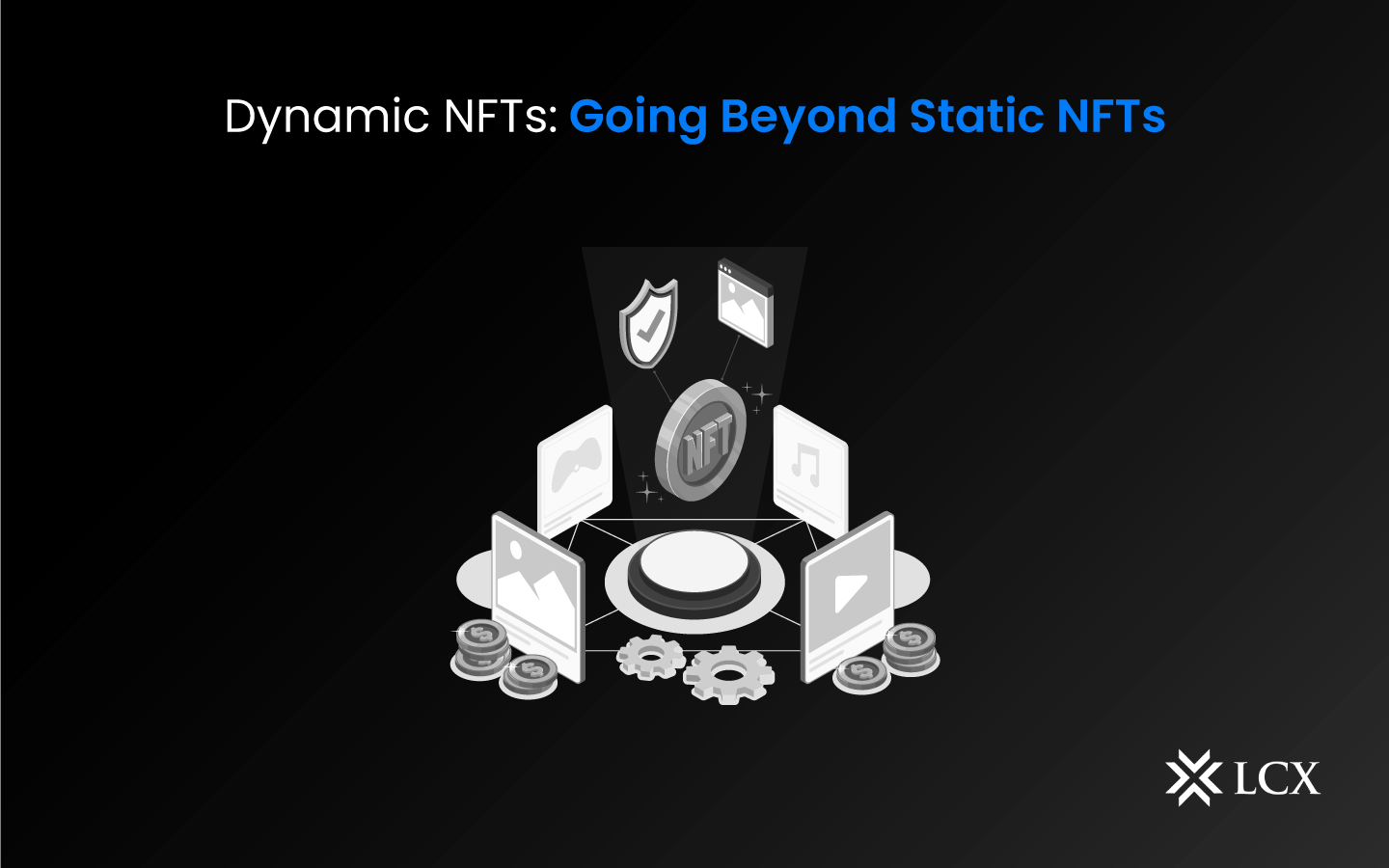
An overview of Dynamic NFTs
za LCX Team · · Updated September 12, 2024
Soon after attaining widespread popularity in the Web3 space, dynamic NFTs have begun to make their way into the mainstream, with prominent athletes and prominent individuals launching their own collections. NFTs are now one of the most visible use cases for blockchain technology.
The next stage in the development of NFTs has just begun. dNFTs are broadening the design space that NFTs can address by adapting and modifying in accordance with external events and data. A subcategory of NFTs known as “dynamic NFTs” exists within the broader category of NFTs.
These NFTs differ significantly from their immutable versions in that they can evolve due to smart contracts and the encoding of their creator’s requirements.
What Are Dynamic NFTs?
Static NFTs are presently the most prevalent form of NFT, used primarily for NFT art projects, play-to-earn games, and digital collectibles. In addition to these use cases, they offer an exceptional benefit for digitizing real-world objects, such as property deeds, trademarks, and other sorts of individual identification numbers.
However, this approach is constrained by the immutability of static NFTs, whose metadata remains static once they are issued on a blockchain.
Frequently, data must be updated for applications such as tokenizing assets from the real world, developing evolution-based video games, and establishing blockchain-based fantasy sports leagues. With dNFTs, users get the best of both worlds: NFTs have their own distinct identifiers while still having the flexibility to have their metadata updated.
A dynamic NFT is one that can alter in response to external conditions. Change in a dynamic NFT typically refers to a modification of the NFT’s metadata activated by a smart contract. This is accomplished by incorporating automatic changes within the NFT smart contract, which instructs the underlying NFT on how and when its metadata should change.
The architecture of dynamic NFTs has been built to adapt to outside variables or conditions, such as user behavior, actual time price fluctuations, time and weather, and other environmental data.
Overall, NFTs are based on cutting-edge blockchain technology, which enables the creation of verifiable and immutable ownership and authenticity records. Not even dynamic NFTs are exempt.
When an artist creates a dynamic NFT, he or she defines the principles governing how the NFT can evolve or change over time. These parameters can be stored as code, such as in Ethereum’s Solidity code.
The token standard is the primary difference between traditional NFTs and dynamic ones. Consequently, dynamic NFTs operate by recording data in an editable format. The ERC-721 token standard is typically used to construct static NFTs, while the ERC-1155 token standard is used to create them. This token standard is typically referred to as “semi-fungible” because it can be altered as necessary.
Moreover, the use of smart contracts, which are autonomous programs encoded within the NFT, makes NFT dynamics conceivable. These smart contracts automate certain tasks, such as modifying the NFT’s appearance, animations, or behavior based on particular conditions. In addition, they facilitate a variety of interactions, such as enabling individuals to connect with the NFT in a virtual environment.
Smart contracts also specify how these can be transferred, purchased, and traded, as well as how their creators’ royalties should be distributed. Users need a digital currency wallet that allows smart contracts in order to interact with dNFTs. Then people can buy, sell, and trade NFTs on NFT exchanges, or put them to use in decentralized applications (DApps) that promote and take advantage of NFTs’ inherent flexibility.
Applications of Dynamic NFTs
Collaboration, programming ability, adaptability, and the development of additional sources of income for artists and collectors are some of the key benefits of dynamic NFTs.
- It provides a high level of interactivity. Flexibility and adaptability make them more engaging and intriguing for collectors and audiences, while opening up new creative expression possibilities.
- Because they can be programmed, NFTs can be highly automated and controlled, opening up opportunities for novel use cases and applications across a wide range of sectors. A changing NFT could stand in for a game’s evolving protagonist or an item that gains new skills as the player does.
- Beyond digital art, these can be implemented in a variety of services, including gaming, social networks, and others. Their versatility affords developers and creators new opportunities to innovate and create immersive user experiences.
- dNFTs provide artists with new income sources. They offer a thrilling source of long-term income for creators, as they can earn rewards on their NFTs’ continued use or interaction.
Conclusion
Dynamic NFTs are a revolutionary development in the realm of digital assets. These tokens promise a level of interaction and connection that traditional non-fungible currencies simply cannot surpass due to their capacity to adapt and develop over time. These have been shown in a variety of scenarios and applications, ranging from gaming and entertainment to art and collectibles.
As the technology and ecosystem surrounding them keep developing, it is evident that this fascinating phenomenon will play an ever-increasing role in influencing the coming years of digital ownership and value exchange.