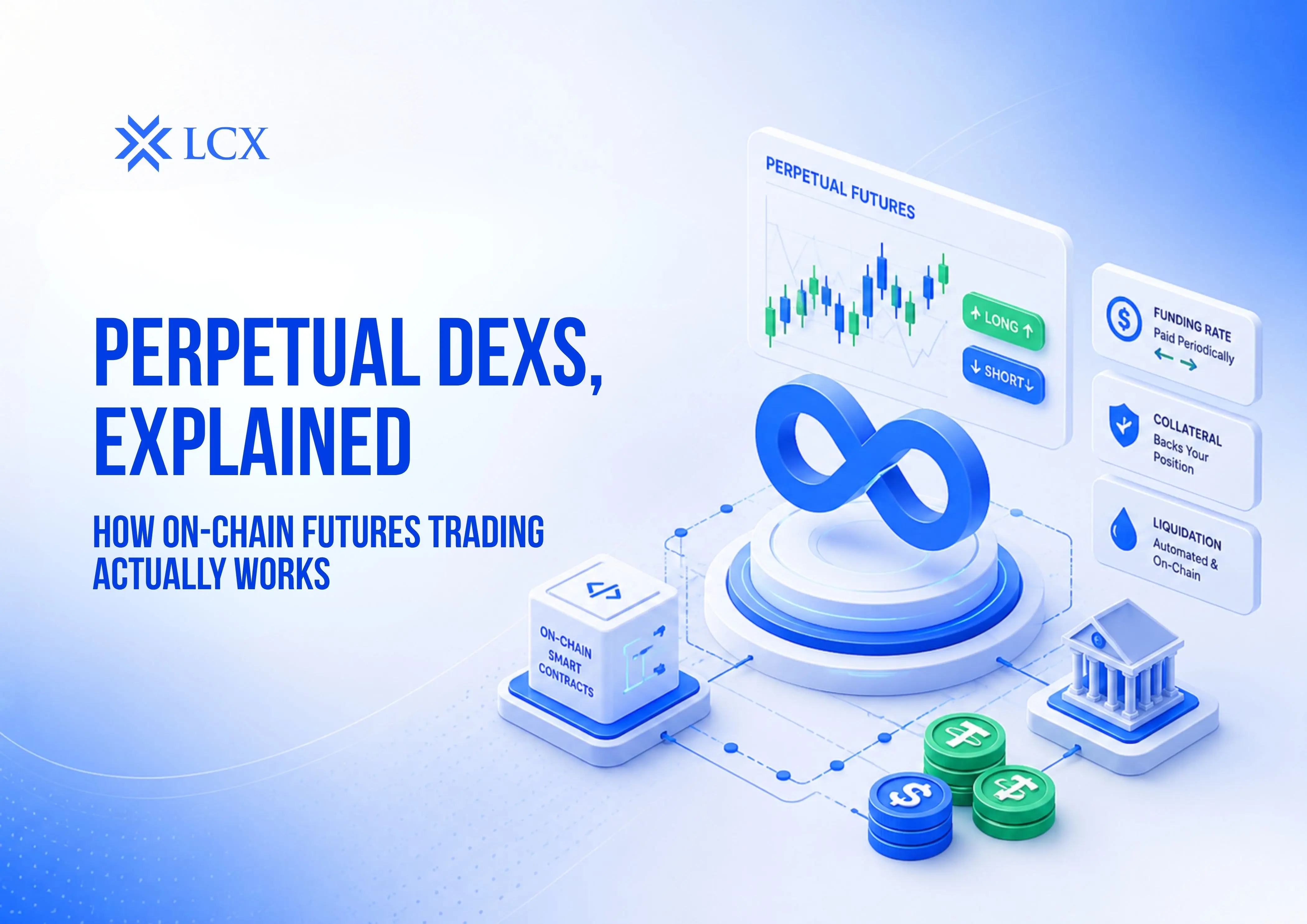
Perpetual DEXs, Explained: How On-Chain Futures Trading Actually Works
до LCX Team ·
If you’ve spent any time around DeFi lately, you’ve probably heard the term “perp DEX” thrown around, often alongside eye-popping trading volume numbers or revenue figures that rival centralized exchanges. But what actually is a perpetual DEX, and how does it manage to replicate something as complex as leveraged futures trading without a company running the order book?
This post breaks down the mechanics from the ground up.
Starting With the Basics: What Is a Perpetual Contract?
Before getting to the “decentralized” part, it helps to understand the “perpetual” part.
A perpetual futures contract (or “perp”) is a derivative, a financial instrument whose value is derived from an underlying asset, like Bitcoin or Ethereum that lets you speculate on price movement without ever owning the actual asset. It works like a traditional futures contract with one key difference: it has no expiration date. You can hold the position for an hour, a day, or a year.
This makes perps popular for two reasons:
- Leverage: You can control a much larger position than your actual capital, amplifying both gains and losses.
- Flexibility: You can go “long” (betting the price rises) or “short” (betting the price falls) without needing to borrow or hold the underlying asset yourself.
The Problem: How Do You Keep a Contract With No Expiry Tethered to Reality?
If a contract never expires, what stops its price from drifting away from the actual market price of the asset it’s tracking? This is where the funding rate comes in arguably the most important mechanic to understand.
Periodically (often every hour), the exchange calculates the difference between the perpetual contract’s price and the underlying spot price. If the perp is trading above spot (meaning more people are betting long), long position holders pay a small fee to short position holders. If the perp is trading below spot, the reverse happens.
This creates a constant financial incentive pulling the contract price back toward the real-world spot price, a self-correcting mechanism that doesn’t require anyone to manually intervene.
Now, the “Decentralized” Part
On a centralized exchange (like Binance or Coinbase), a company operates a traditional order book, a running list of buy and sell orders that get matched by the exchange’s internal software. The company custodies your funds, matches your trades, and handles liquidations.
A perpetual DEX removes the company from that equation. Instead, trades are executed through one of two dominant models:
1. Liquidity Pool Model
Traders don’t trade against other traders directly; they trade against a shared pool of deposited funds. Liquidity providers (LPs) deposit assets into this pool and, in exchange, earn a share of the trading fees. When a trader opens a long position and profits, that profit is paid out from the pool; when they lose, the pool absorbs the gain. The pool essentially acts as the counterparty to every trade.
2. On-Chain Order Book / Matching Engine Model
Some perp DEXs instead maintain something closer to a traditional order book, but with matching and settlement happening transparently on-chain (or on a specialized high-speed layer built for this purpose). This tries to replicate the price discovery of a centralized exchange while keeping custody and settlement decentralized.
Either way, the core shift is this: no single company holds your funds or has final say over whether your trade executes. Smart contracts, self-executing code deployed on the blockchain enforce the rules automatically.
Collateral, Leverage, and Liquidation
To open a leveraged position, you deposit collateral (often a stablecoin or the asset itself). This collateral backs your position, if the market moves against you enough that your losses approach your collateral’s value, the protocol automatically liquidates your position to prevent it from going negative.
This liquidation isn’t performed by a customer support team, it’s typically executed by automated bots or smart contract logic that constantly monitor position health across the protocol, stepping in the moment a threshold is breached.
Why This Matters in the Bigger DeFi Picture
Perpetual DEXs represent one of the clearest examples of DeFi capturing real economic activity that used to be exclusive to centralized platforms. Trading fees, funding rate payments, and liquidation mechanics all generate genuine revenue for these protocols not speculative token incentives, but fees paid by actual traders for actual services rendered.
This is part of why perp DEX activity is often cited as evidence that DeFi is maturing beyond its earlier, more speculative phase: its infrastructure doing the same job as a traditional exchange, just with different custody and governance assumptions underneath it.