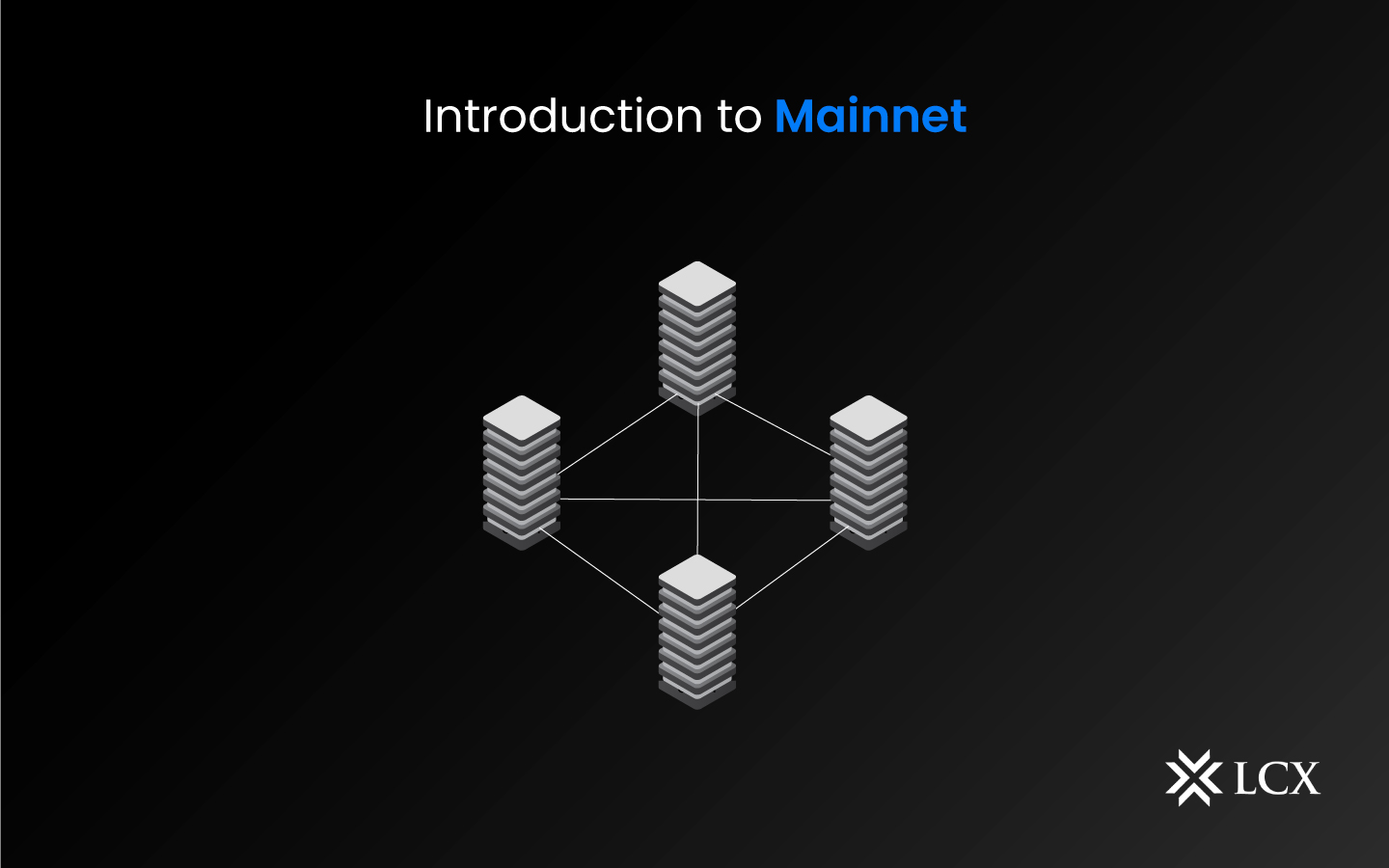
Introduction to Mainnet
από LCX Team · · Updated November 15, 2023
Introduction
The emergence of blockchain technology has revolutionized how we think about transactions, data storage, and the internet. One of the most critical components of blockchain technology is the mainnet. The mainnet is the primary blockchain network that enables the creation and transfer of digital assets.
What Is a Mainnet?
A mainnet is a decentralized blockchain that operates its own network using its own technology and protocol. It is a live blockchain that utilizes its own cryptocurrencies or tokens, as opposed to a testnet or projects operating on top of other popular networks such as Ethereum. Programmers use the testnet to troubleshoot and evaluate any new blockchain features. The primary distinction between testnets and mainnets is that the former is an ongoing blockchain initiative, whereas the latter is a fully developed blockchain.
Several crucial stages may occur prior to the mainnet stage. These can include a token sale and financing a product’s production and testing of features. Upon effective implementation of this phase, the mainnet phase is typically implemented. This would indicate that the blockchain is completely operational.
During the ICO, many blockchain firms elected to use their own tokens pegged to the Ethereum network. These ERC-20 tokens are designed for use exclusively on Ethereum’s platform. When the ICO concludes, the mainnet is released. The mainnet uses native tokens as opposed to ERC-20. The subsequent phase is known as the mainnet switch. This entails an exchange between ERC-20 tokens and new coins on the blockchain. Upon completion of the mainnet exchange, the old coins are typically destroyed. This ensures that only fresh coins are used.
How Mainnets Work?
Initial blockchain project code is deployed in a staging environment known as a testnet. The sandboxed environment enables project developers to test new code and refine the logic for updates and branches without affecting the live mainnet. After passing quality assurance (QA) in the staging environment, the code is migrated to the mainnet production environment and made accessible to the public.
When a user initiates a network transaction, it is broadcast to all network nodes. By solving complex mathematical puzzles, miners then contend to add the transaction to the subsequent block of the blockchain. The amount of cryptocurrency awarded to the first miner to solve the puzzle and submit the transaction to the blockchain is predetermined. This motivates miners to partake in the procedure.
Why Do We Need a Mainnet?
The launch of a mainnet essentially transforms cryptography from a theoretical concept into a practical application. Mainnets are the foundation of the emerging decentralized crypto-financial system. With the introduction of mainnets, the crypto revolution began. Midway through 2009, Satoshi Nakamoto, a supposedly anonymous programmer, launched the Bitcoin mainnet. The launch occurred less than a year after Nakamoto published the first crypto “whitepaper” delineating the working theory of Bitcoin. Litecoin’s mainnet was introduced in 2011 and Dogecoin’s in 2013. In 2015, the Ethereum mainnet became the first to support smart contracts.
What Are the Components of Mainnet?
Mainnets consist of distributed computational nodes that can connect to form a peer-to-peer (P2P) network for a particular cryptocurrency. Mainnet components consist of network nodes, a cryptocurrency that provides economic incentives for users to support the network, a consensus network that enables nodes to verify and validate transactions, and linked storage blocks – hence the name blockchain.
Mainnet nodes: Nodes are the individual processors or servers that comprise a crypto mainnet. They rely on the participation of network nodes that are financially rewarded for validating, processing, validating, and recording user transactions.
Nodes can be classified in two distinct ways:
Full nodes store the complete blockchain history. Each full node in the network keeps a copy of the network’s distributed ledger to ensure that data recorded in the blockchain ledger is always accessible, even if multiple nodes fail. Full nodes can validate transactions independently and are resource-intensive.
Light nodes store a subset of blockchain data. Light nodes contribute to the scalability of the network by enabling more users to interact with the blockchain, even if they lack the computational resources to operate a full node.
To optimize network performance and establish a balance between the requirements for decentralization, security, and scalability, most mainnets are designed to support both full and light nodes. Certain mainnets, such as Ethereum, require a greater number of full nodes to support smart contracts and decentralized applications (dApps).
Cryptocurrency: Most mainnets have their own native cryptocurrency to support transactions and recompense the miners, validators, and stakeholders who contribute their resources and computational power to maintain the network, validate transactions, and ensure the security of the mainnet.
Consensus mechanism: A consensus mechanism is a system of rules that governs the validation and recording of transactions on a blockchain. Proof of Work (PoW) and Proof of Stake (PoS) are the most typical consensus mechanisms. Mechanisms of consensus ensure that only legitimate transactions are added to the blockchain of the mainnet.
Blocks: A block is a unit of data storage. Each block on a mainnet stores a group of transactions, a timestamp, and a cryptographic hash that references the preceding block in the chain. The interconnected blocks produce a secure, chronological, and tamper-resistant record of all network transactions.
Conclusion
In conclusion, a mainnet is a critical component of any blockchain system. It is the live and operational version of the blockchain where all transactions are processed and validated. A mainnet ensures the integrity of transactions and the overall security of the blockchain, and it is necessary for the development of dApps on the blockchain. Consensus algorithms, network layers, smart contract layers, and transaction layers are all essential components of a mainnet. By understanding the role of a mainnet in blockchain technology, we can better appreciate the importance of this revolutionary technology and its potential to transform industries and society as a whole.