Modular Blockchains Are Quietly Eating the Industry And Most People Haven’t Noticed
από LCX Team ·
The biggest structural shift in blockchain since Ethereum isn’t a new coin. It’s the dismantling of how blockchains are built.
Imagine if every appliance in your home ran on the same engine: your fridge, your washing machine, your microwave, all sharing one motor that had to do everything at once. It would work, barely. But it would never be efficient, and one overload could slow everything down.
That’s essentially how blockchains like early Ethereum were built. One chain. One engine. Execution, security, data storage, and consensus all crammed into a single layer. It was elegant in its simplicity and a bottleneck by design.
Modular blockchains are the fix. And in 2026, they’re quietly becoming the default architecture for anyone building seriously in this space.
What “modular” actually means
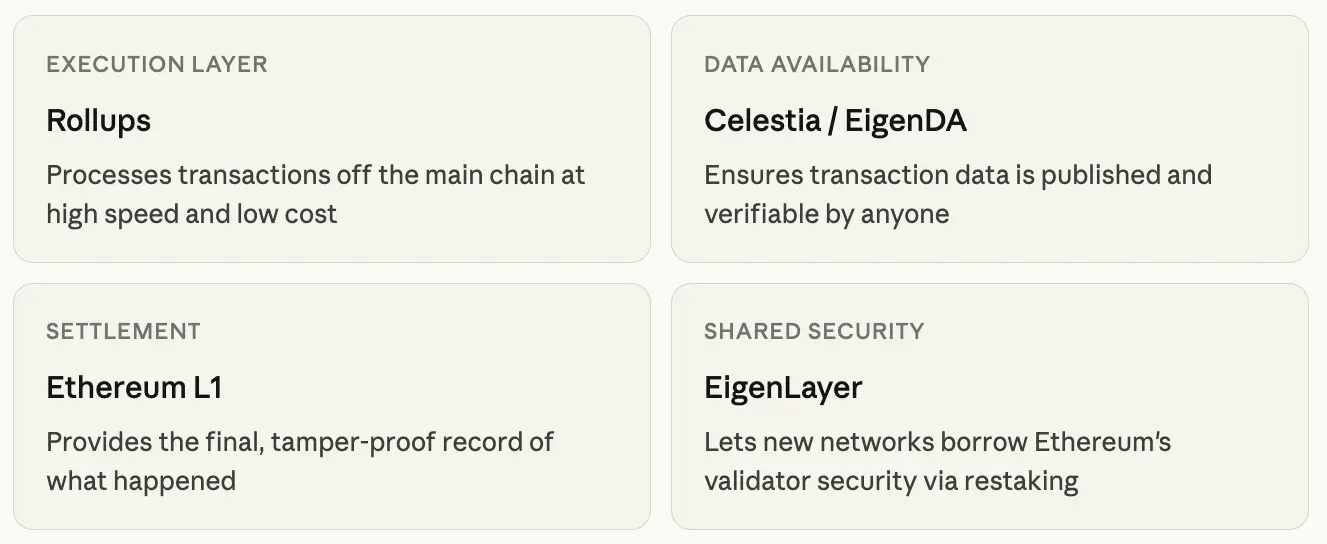
A monolithic blockchain handles four core jobs simultaneously: execution (processing transactions), settlement (finalizing the results), consensus (agreeing on ordering), and data availability (making sure transaction data is published and accessible). When demand spikes, all four jobs compete for the same resources and fees skyrocket, speeds drop, and the whole thing groans under pressure.
Modular blockchains break these jobs apart. Each layer specializes. One chain handles execution. Another handles data availability. Another provides settlement. You mix and match based on what your application actually needs, like a LEGO system instead of a carved block of stone.
The players driving the shift
Two projects have become the clearest symbols of this movement. Celestia pioneered the idea of a dedicated data availability layer, it doesn’t execute transactions or handle settlement at all. It just orders data and guarantees it’s available. By mid-2025, over 56 rollups were already using Celestia, with every major rollup framework, Arbitrum Orbit, OP Stack, and Polygon CDK, offering it as a data availability option. By early 2026, the network had processed over 160 GB of rollup data and counting.
EigenLayer takes a different angle. Rather than building a new base layer, it extends Ethereum’s existing security to other services through “restaking”, Ethereum validators can reuse their staked ETH to help secure additional networks and services. It currently holds roughly $18–19 billion in restaked value. Its data availability arm, EigenDA, has achieved 100MB per second throughput, far beyond what earlier systems could manage.
Posting data to specialized availability layers can reduce costs by over 99% compared to publishing directly to Ethereum Layer 1, enabling sub-cent transaction fees that make decentralized apps genuinely competitive with traditional software.
Why this matters beyond the technical specs
The economic argument is hard to ignore. When a gaming app no longer has to share block space with a high-frequency trading protocol, both can run faster and cheaper. A social media application can choose a data availability layer optimized for cheap, high-volume writes. A DeFi protocol can prioritize settlement finality. The one-size-fits-all model is becoming one-size-fits-none.
There’s also a developer story here. Rollup-as-a-service platforms now let teams spin up their own application-specific chains without deep blockchain engineering expertise, selecting from pre-built execution environments, security layers, and data availability options like components in a catalog. What once required months of custom chain development can now take days.
The honest caveat
Modular architecture introduces real complexity. More specialized layers mean more bridges between them and bridges have historically been the most exploited surface in blockchain. Most modular networks haven’t yet accumulated the adversarial track record of Ethereum or Bitcoin, and composing multiple layers together can introduce failure modes that even good audits miss.
The infrastructure is real. The adoption is growing. The security track record is still being written.
But the direction is clear. The next generation of blockchain isn’t a single, bigger chain, it’s a well-coordinated stack of specialized ones. Most users will never see the layers underneath. They’ll just notice that things are faster, cheaper, and don’t grind to a halt when the market moves.
That’s the quiet revolution modular blockchains are delivering. Piece by piece.