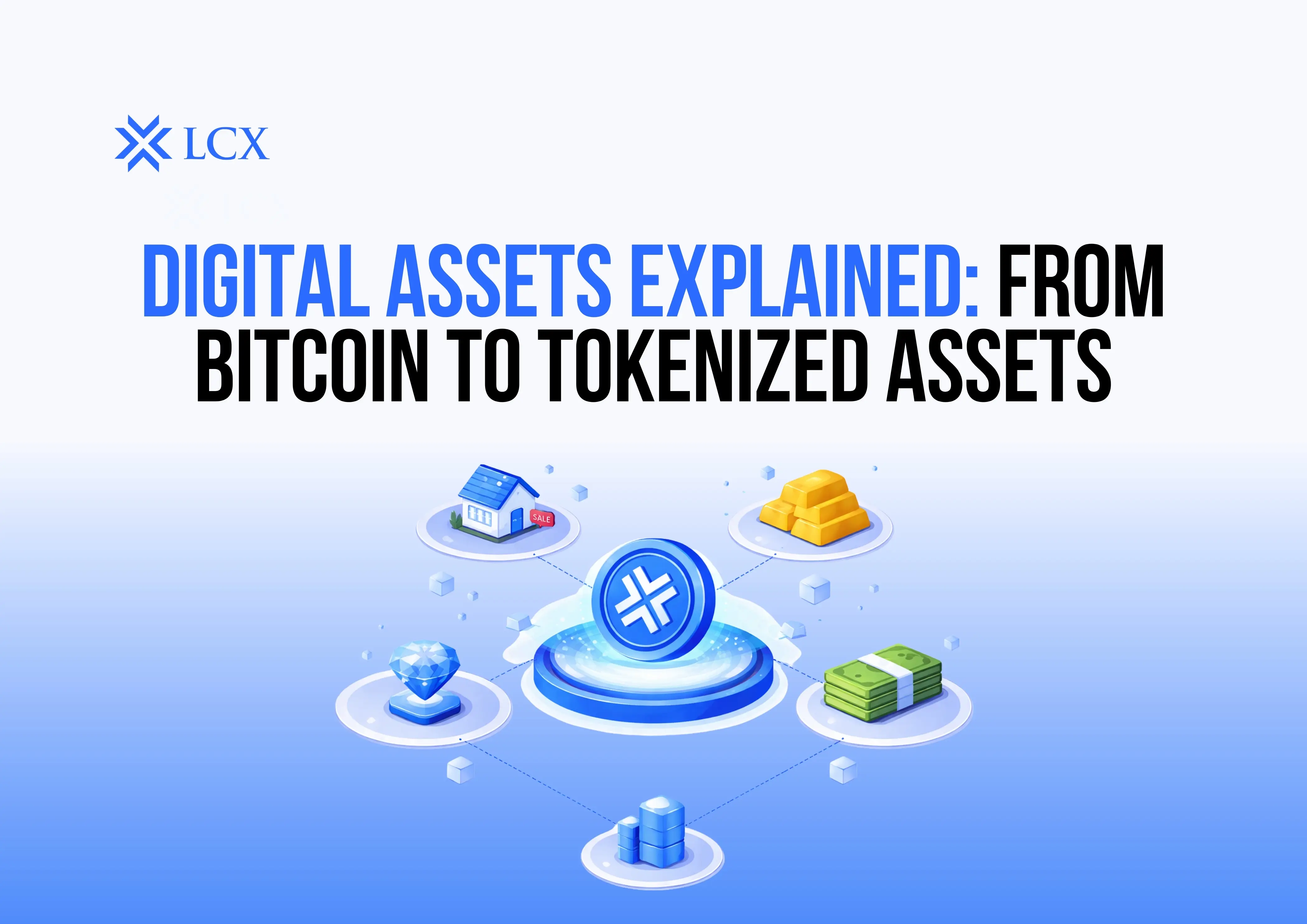
Digital Assets Explained: From Bitcoin to Tokenized Assets
di LCX Team ·
What Are Digital Assets?
Digital assets are any assets that exist in a digital form and derive value from ownership, utility, or rights. In the context of blockchain and crypto, digital assets are secured by cryptography and recorded on decentralized networks. These assets can represent currency, ownership, access rights, or even real-world value.
Unlike traditional assets, digital assets are not controlled by a central authority. Instead, they operate on distributed ledger technology, ensuring transparency, security, and immutability.
Bitcoin: The Foundation of Digital Assets
Bitcoin was the first digital asset to gain global recognition. Introduced in 2009, it was designed as a decentralized digital currency that allows peer-to-peer transactions without intermediaries such as banks.
Bitcoin’s value is driven by scarcity, demand, and its role as a store of value. It is often referred to as “digital gold” because of its limited supply and growing adoption among investors and institutions.
Bitcoin laid the foundation for the broader digital asset ecosystem by proving that decentralized systems can operate securely at scale.
Beyond Bitcoin: The Rise of Cryptocurrencies
Following Bitcoin, thousands of cryptocurrencies have emerged, each designed with specific use cases. Ethereum, for example, introduced smart contracts—self-executing agreements that run on blockchain networks.
These innovations expanded the scope of digital assets beyond simple payments. Cryptocurrencies now support decentralized finance (DeFi), gaming, identity systems, and more. Tokens can represent governance rights, access to services, or participation in decentralized applications.
This evolution has transformed digital assets into a diverse and rapidly growing asset class.
Utility Tokens and Their Role
Utility tokens are a category of digital assets designed to provide access to a product or service within a specific ecosystem. Unlike traditional financial instruments, their value is tied to their functionality rather than ownership or profit expectations.
For example, exchange tokens can be used for trading fee discounts, platform access, or participation in ecosystem features. These tokens play a practical role in enabling seamless interaction within blockchain-based platforms.
Their importance lies in driving engagement and utility within digital ecosystems.
Tokenization of Real-World Assets
One of the most significant developments in the digital asset space is the tokenization of real-world assets (RWAs). Tokenization involves representing physical or traditional assets—such as real estate, gold, or diamonds—on a blockchain as digital tokens.
This process offers several advantages. It increases accessibility by allowing fractional ownership, improves liquidity by enabling easier trading, and enhances transparency through blockchain records.
Tokenized assets bridge the gap between traditional finance and blockchain technology, creating new opportunities for investors and institutions alike.
Security and Ownership in the Digital Age
Ownership of digital assets is managed through private keys, which provide access to wallets where assets are stored. This model gives users full control over their assets, but also places responsibility on them to manage security.
Technologies such as hardware wallets and secure exchanges play a crucial role in protecting digital assets. Additionally, regulatory frameworks are evolving to ensure safer participation in the digital economy.
Understanding how to securely store and manage digital assets is essential for anyone entering this space.
The Future of Digital Assets
Digital assets are continuing to evolve, driven by technological innovation and increasing adoption. From decentralized finance to tokenized real-world assets, the scope of what can be digitized is expanding rapidly.
As regulatory clarity improves and infrastructure matures, digital assets are expected to become a fundamental part of the global financial system. They offer a more inclusive, transparent, and efficient way to manage and transfer value.
In conclusion, digital assets have grown from a single innovation—Bitcoin—into a broad ecosystem that includes cryptocurrencies, utility tokens, and tokenized assets. Understanding these categories is key to navigating the future of finance.