


Is Bitcoin too volatile to risk your retirement on?

You stack sats. You farm yield, and you’d rather sell your car than part with your BTC. But does that mean you should bank your golden years on Bitcoin?
Many retirement industry professional such as MIT finance professor Jonathan Parker say there is a sweet spot level for crypto exposure in a diversified retirement portfolio:
“Yes, zero.”
Parker, whose research spans portfolio choice, personal finance, retirement finance and Bitcoin, is unusually blunt about where the cryptocurrency belongs. But it’s a view shared by the average citizen.
A recent survey by the National Institute on Retirement Security found that 77% of Americans consider cryptocurrency in workplace retirement plans as risky.
But regulators and investment firms alike have been steadily opening the door to greater crypto exposure in retirement savings in recent years.
BlackRock, for example, says a 1%-2% Bitcoin allocation can be reasonable for a diversified portfolio, where investors can tolerate the risk, while Fidelity says allocations of 2%-5% could improve retirement outcomes. A smaller position allows investors to benefit from Bitcoin’s volatility while limiting the downside.
But there’s a more interesting question than whether crypto is too risky in the abstract.
Can you be a passionate believer that Bitcoin is the ultimate in sound money, or that Ether will be the future of finance — and still decide your retirement savings are better off without it?
Bitcoin is already creeping into retirement portfolios
Ryan Firth is the founder of Mercer Street Personal Financial Services, a financial planner who specializes in digital assets. He views Bitcoin as something that can sit within a conventional portfolio rather than a stand-alone retirement bet. He says BTC can potentially replace some stock exposure rather than simply being piled on top of it. He tells Magazine:
“Bitcoin offers higher return potential than stocks but with more volatility.”
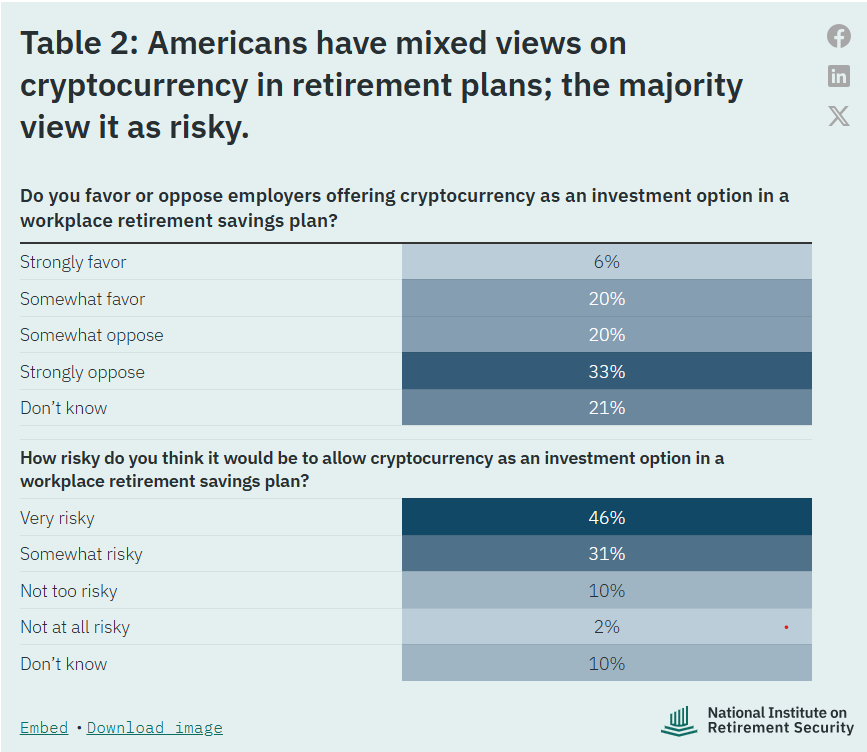
Americans have mixed views on cryptocurrency in retirement plans. Source: National Institute on Retirement Security
He says his general rule of thumb is that crypto assets shouldn’t make up more than 5% of your investable assets, adding:
“The conservative approach is to invest only what you are willing to potentially lose.”
Related: US lawmakers push back on Labor Department plans to include crypto in 401(k)s
Retirement funds are taking positions themselves
The average person might think the crypto industry is too risky, but institutional investors see it as an opportunity.
Public filings show pension funds and other large investors holding regulated spot Bitcoin exchange-traded funds (ETFs), while others have gained exposure through publicly traded companies closely tied to the sector.
CalPERS, for example, the largest public pension fund in the United States, has disclosed an investment in Strategy, the largest corporate Bitcoin treasury holder, as part of its index-oriented public equity portfolio.
CalSTRS, is the largest educator-only pension fund. While it tells Magazine it has not made direct investments in cryptocurrency it has invested in firms that “some might consider crypto companies,” such as Coinbase, “a publicly traded company that operates a cryptocurrency exchange platform.”
That difference here is that institutional investors are trying to gain exposure to the growth of the crypto industry, rather than just making Bitcoin a core retirement asset.
Your retirement portfolio has one job Bitcoin doesn’t
Bitcoin’s frequent drawdowns and year long bear markets make it a tricky asset to hold for those nearing or in their retirement years.
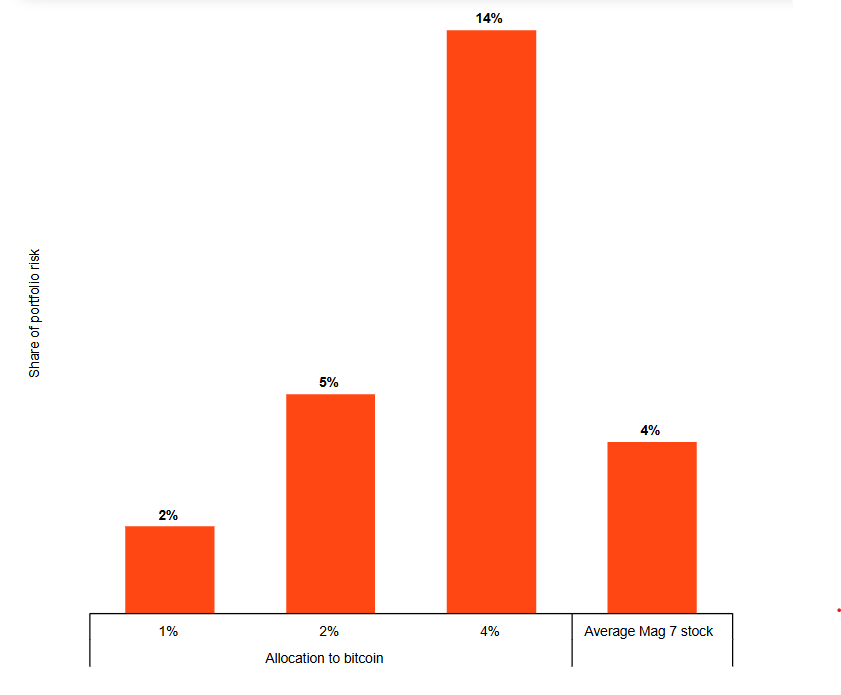
BlackRock recommends up to a 2% Bitcoin allocation, where investors can tolerate risk. Source: BlackRock
When you’re young a drawdown is just a blip among a wider uptrend. When you are retired, spending retirement savings that have fallen significantly in value magnifies the damage considerably.
Related: Coinbase launches crypto service for Australian retirement funds
Bill Bengen, the financial planner and researcher whose work gave rise to the widely cited 4% retirement withdrawal rule, says capital preservation should be the “primary priority” for retirement portfolios.
He tells Magazine that although volatile assets like Bitcoin “can be useful,” he recommends limiting them to no more than 5% of a retirement portfolio to “help prevent a disaster.”
Firth says the question is not simply whether Bitcoin will recover, but if investors can afford to wait that long:
“Will they stay invested and avoid a knee-jerk reaction when prices inevitably fall? [...] What if crypto goes to zero? How would that disrupt their plans and what’s their backup plan?”
What if your investment thesis is wrong?
This question has crossed the mind of even the staunchest Bitcoin HODLer: how much of your future should depend on one investment thesis being right?
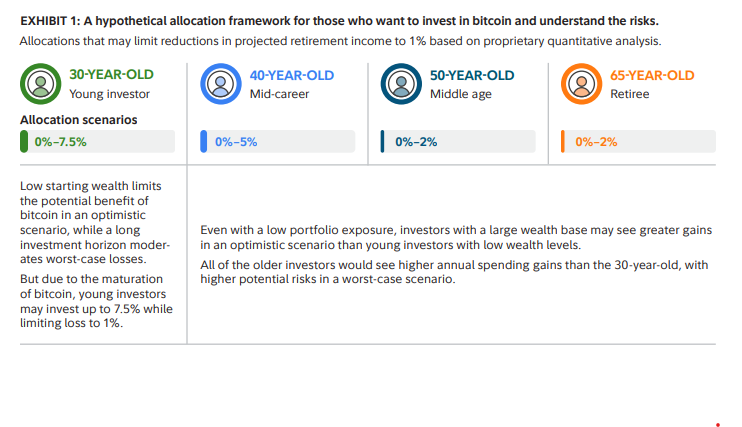
A hypothetical allocation framework for those who want to invest in Bitcoin. Source: Fidelity
What happens if you haven’t just wasted your life’s work but your retirement fund, if Bitcoin falls victim to quantum attackers, or if something better than Bitcoin is invented.
Bengen says many people believe AI is in a bubble.
“Bubbles eventually pop. The same could be said for Bitcoin.”
That problem rings true for anyone building a retirement portfolio around a high-conviction investment, since conviction does not eliminate the possibility of being wrong.
Parker says investors shouldn’t hold cash in retirement accounts and shouldn’t hold peer-to-peer digital cash either.
“Currencies are for transacting, not investing. Bitcoin is no different. People should invest in real assets that pay interest, coupon payments, or dividends.”
He says investors who want exposure to the success or failure of the crypto industry should own the equity or debt of companies that generate revenue from it, rather than holding Bitcoin itself.
You can believe in crypto without betting your retirement on it
If your retirement savings aren’t in Bitcoin, that doesn’t make you any less committed to its long-term growth.
You don’t have to choose between believing crypto is the future and casting it as a speculative gamble with no place in a serious portfolio, as Firth advises:
“It doesn’t have to be an all-or-nothing proposition.”
You can still believe crypto will change the world — without making your retirement depend on being right.
Magazine: Recovery specialists crack $1B crypto wallet... but find just $10
Cointelegraph publishes long-form journalism, analysis and narrative reporting produced by Cointelegraph’s in-house editorial team with subject-matter expertise. All articles are edited and reviewed by Cointelegraph editors in line with our editorial standards. Some articles contain affiliate links, from which Cointelegraph may earn a commission. These relationships do not influence which products we review or our editorial conclusions. Content published in here does not constitute financial, legal or investment advice. Readers should conduct their own research and consult qualified professionals where appropriate. Cointelegraph maintains full editorial independence.