Roots of DeFi
von LCX Team ·
DeFi has become the core element of the future of finance. It has many use-cases such as smart contracts, decentralization, DLT (Distributed Ledger Technology) and blockchain, open banking system, and disintermediation.
Decentralized technologies such as DLT and blockchain are not the only ways to achieve decentralization. Furthermore, many distributed ledgers employ a hierarchical, centralized governance model that limits access to only those with authority. However, decentralized does not always imply scattered.
DeFi intelligence
DeFi space’s growth pattern depends on two primary growth laws: Kryder’s and Moore’s laws. Where Moore’s law states that the capacity of data processing increases at an exponential rate, Kryder’s law holds the same for data storage ability.
Tremendous savings are achieved through increased data processing power and storage capacity. Hardware virtualization enables the development and deployment of service-oriented architecture, which is central to DeFi. Interestingly, Kryder’s, Moore’s, and bandwidth expansion at falling costs apply concurrently, implying that machine learning (ML) and other types of artificial intelligence (AI) will advance further.
Roots Of DeFi
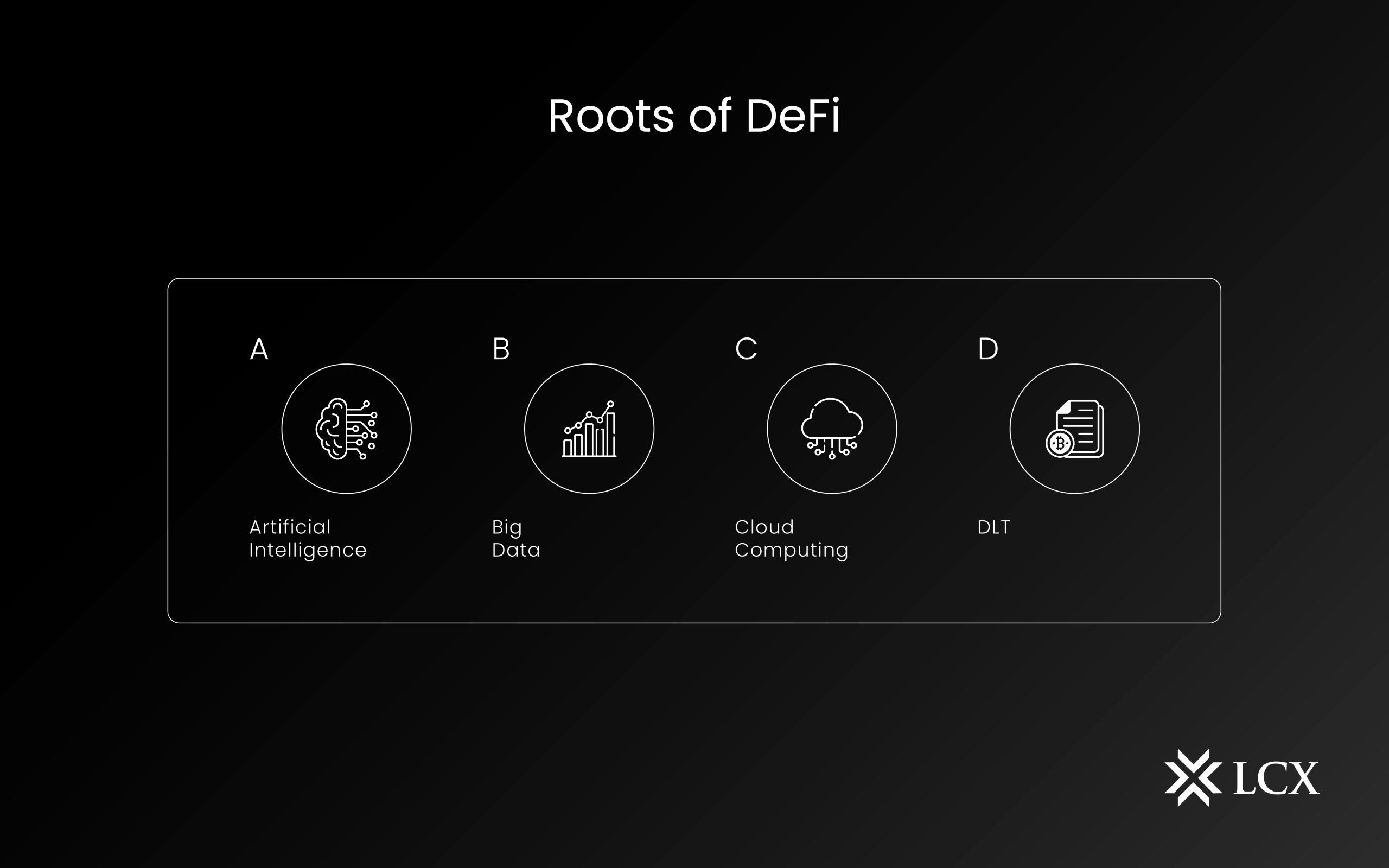
DeFi is built around four primary technologies best represented by the acronym “ABCD,” ABCD is short for Artificial Intelligence, Big Data, Cloud Computing, and Distributed Ledger Technology.
- Artificial Intelligence: AI is based on developing software mimicking human cognitive abilities such as “learning” and “problem-solving.” The more the data, the more precise the conclusions can be drawn.
DeFi’s primary advantage is the vast amount of data generated around financial transactions publicly. This massive amount of data can be used for the development and training of artificial intelligence models.
- Big Data: Data is at the core of all DeFi innovation, resulting from the digitization of a growing number of processes. The increasing volume of data allows for both traditional data analytics and big data techniques to be used. Big data analytics are used in cases where analysis and collection of data sets are too complex for conventional methods. Big Data applications analyze massive amounts of data and employ cutting-edge data analytics techniques in their functions. DeFi data analysis thus refers to interpreting, identifying, and communicating relevant patterns in DeFi protocol data and applying such practices to make decisions.
- Cloud computing: Cloud computing provides users with storage and computational capacity without requiring them to operate and own the servers that use these services. This is rooted in commercial data centers renting ability to consumers who access it via the internet. Therefore, cryptography aids network security in DeFi and cloud services.
- DLT: A distributed ledger is a networked database that is shared and synchronized by consensus across institutions, multiple sites, or continents, allowing a transaction to have various private or public witnesses. The result of data sharing is a database distributed across a network of servers and serves as a ledger.
A blockchain protocol is also used along with the distributed ledgers. The blockchain makes data corruption even more difficult because a successful cyberattack would have to simultaneously corrupt not just one set of data but all subsequent data sets and the timestamps.
Smart contracts, which aim to address the issue of trust in human interactions while also increasing efficiency, have found a home in distributed ledgers. They are software protocols that run independently and represent some of the terms of a two-party agreement. They are neither intelligent nor legal contracts. The contract terms are directly mentioned in them. Smart contracts allow transactions among dissimilar, anonymous parties to occur without needing an external instrument of power.
Transactions are thus transparent, traceable, and irreversible. All the processes driven by smart contracts are recorded on well-secured distributed ledgers. This combination is at the core of the vast majority of DeFi projects.
Conclusion:
In the not-too-distant future, decentralized computer programs will govern how value is created, exchanged, transmitted, and converted into financial instruments and derivatives. These functions were previously handled by the traditional financial industry that will have to adopt the technology of DeFi. It is safe to say that DeFi will replace historical economic infrastructure and usher in an era of “integrated value exchange.”