Fully Homomorphic Encryption (FHE): Private Computation on Public Blockchains
oleh LCX Team ·
Public blockchains are built on a simple promise: anyone can check everything. Every balance, every transfer and every smart contract call sits in the open, ready to be verified by any node on the network.
That transparency is what makes blockchains trustworthy. It is also what keeps many people and institutions away. A company does not want competitors reading its payroll. A trader does not want bots seeing a large order before it fills. A bank cannot put client positions on a ledger the whole world can read.
For years, the industry has tried to fix this with mixers, privacy coins, zero-knowledge proofs and trusted hardware. Each solves part of the problem. Fully Homomorphic Encryption (FHE) goes after the whole thing: it lets a blockchain run computations on data that stays encrypted the entire time, so the network can process a transaction without ever seeing what is inside it.
This guide explains what FHE is, how it works on a blockchain, how it compares with zero-knowledge proofs, and where it is already being used, from confidential DeFi to private stablecoins and sealed-bid auctions.
What is Fully Homomorphic Encryption?
Fully Homomorphic Encryption is a type of encryption that lets you run calculations on data while it is still encrypted. When you decrypt the result, you get exactly what you would have gotten by running the same calculation on the original, unencrypted data.
With normal encryption, data is safe while it is stored or sent, but it has to be decrypted before anyone can use it. That moment of decryption is where leaks, hacks and snooping happen. FHE removes that moment. The data is never exposed, not even to the computer doing the work.
A simple analogy
Imagine a jeweller who needs an assistant to shape a bar of gold, but does not trust the assistant with it. So the jeweller locks the gold inside a glovebox: a sealed, transparent box with gloves built into the side. The assistant can reach in and work the gold into a ring, but can never take it out. Only the jeweller holds the key to open the box and collect the finished ring.
FHE works the same way. The data is the gold, the encryption is the glovebox, and the blockchain network is the assistant. It does the work without ever holding the raw data.
What "homomorphic" means
"Homomorphic" means "same shape". Operations on encrypted values mirror operations on the real values. If you encrypt 5 and 3, add the two ciphertexts, and decrypt the result, you get 8:
\text{Dec}\big(\text{Enc}(5) \oplus \text{Enc}(3)\big) = 5 + 3 = 8
Some older schemes support only one kind of operation, either addition or multiplication. They are called partially homomorphic. Fully homomorphic schemes support both, an unlimited number of times. With addition and multiplication you can build any computation, from a token transfer to a lending protocol's interest calculation.
A 30-year puzzle, solved in 2009
The idea dates back to 1978, when Ron Rivest, Leonard Adleman and Michael Dertouzos asked whether computation on encrypted data was possible. For three decades nobody could build it. In 2009, Craig Gentry, then a Stanford PhD student, published the first working FHE scheme.
The catch was speed. Every operation on a ciphertext adds a bit of mathematical "noise". Too much noise and the data can no longer be decrypted correctly. Gentry's fix, called bootstrapping, cleans the noise but was extremely slow: early versions were millions of times slower than normal computing.
The years since have been about closing that gap. Newer schemes such as TFHE (used by Zama) make bootstrapping fast enough for real applications, and dedicated GPUs and chips are pushing it further. That progress is why FHE has moved from research papers to live blockchain networks in 2025 and 2026.
How FHE works on a blockchain
Running FHE directly on every node of a blockchain would be far too slow. Today's networks split the work instead: the blockchain keeps the rules and the record, while a separate network of specialised machines does the encrypted maths.
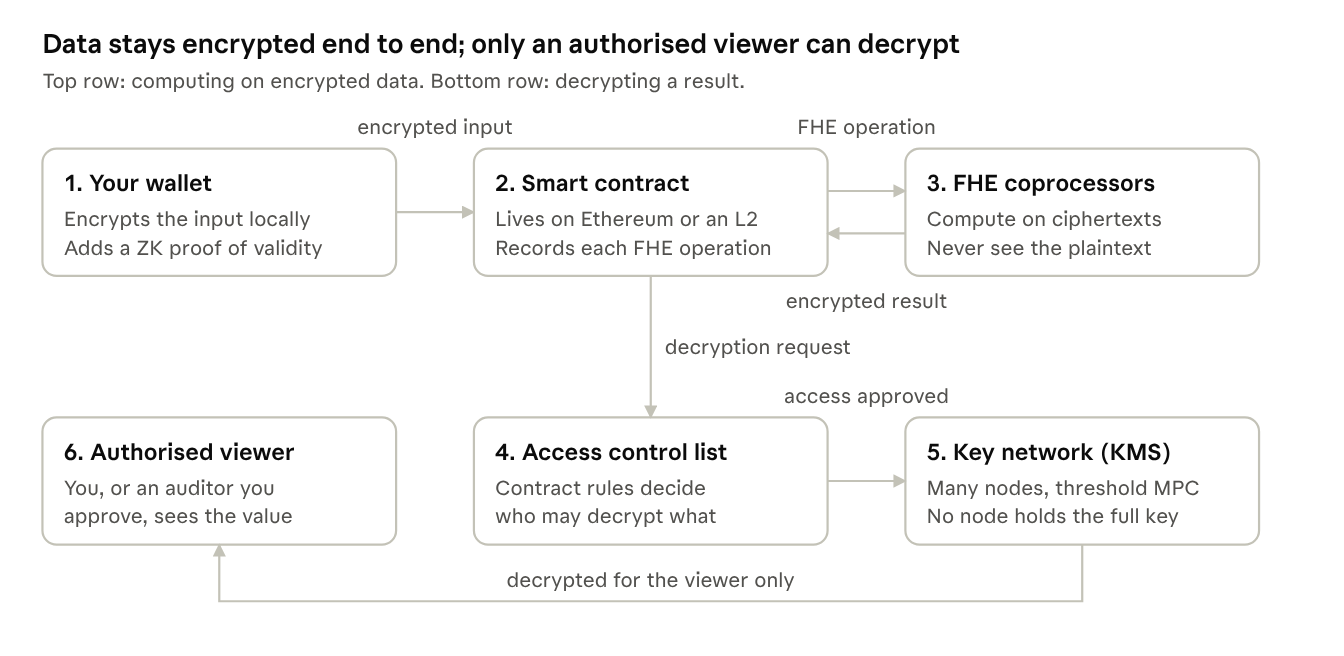
Here is what happens when you send a confidential transaction:
- You encrypt your input. Your wallet encrypts the amount, for example 500 cUSDT, on your own device before it ever leaves. It also attaches a small zero-knowledge proof showing the ciphertext is well-formed, so nobody can submit garbage.
- The smart contract records the operation. The contract on Ethereum (or another chain) does not do the FHE maths itself. It stores a reference, often called a handle, to each encrypted value and emits an event saying, for example, "subtract this encrypted amount from that encrypted balance". This is known as symbolic execution, and it keeps the host chain fast.
- Coprocessors do the encrypted computation. Off-chain FHE nodes pick up the event, run the calculation on the ciphertexts, and commit the encrypted result. Several coprocessors compute the same result independently, so one faulty node cannot cheat.
- Access rules decide who can see the result. The contract keeps an access control list that records which addresses may use or decrypt each ciphertext. You can see your own balance. A regulator or auditor can be granted access to specific values if needed.
- A key network decrypts only for authorised viewers. No single machine holds the master decryption key. It is split among many independent nodes using threshold multi-party computation (MPC). In Zama's design, 13 nodes share the key and the system stays secure as long as fewer than one-third of them misbehave. When an authorised viewer asks to decrypt, the nodes jointly re-encrypt the result to that viewer's personal key, so it is never revealed to anyone else.
The result: everyone can verify that the contract followed its rules, but only the right people can read the numbers.
FHE vs zero-knowledge proofs (and other privacy tools)
FHE and zero-knowledge proofs (ZKPs) are often mentioned together, but they solve different problems. The short version: a ZKP proves something about your data without showing it; FHE lets others compute on your data without seeing it.
A ZKP is like showing a bouncer a card that says "over 18" without revealing your birth date. It is great for proving facts: that you have enough funds, that a transaction follows the rules, or that a batch of transactions was processed correctly (which is how ZK rollups work).
But a ZKP is usually generated by whoever holds the secret data. That works well when each user only touches their own data. It gets hard when an application needs to combine secrets from many users, such as matching orders in an order book, adding up votes, or updating a shared lending pool. FHE handles that case naturally: everyone's encrypted inputs can be mixed in one calculation, and nobody, including the network, sees anyone else's data.
Two other tools sit in the same space:
- Multi-party computation (MPC) splits a secret among several parties who compute on it together. No single party sees the whole secret, but the parties have to stay online and talk to each other constantly.
- Trusted execution environments (TEEs) are secure areas inside a processor, such as Intel SGX or AWS Nitro Enclaves. They are fast, but you are trusting the chip maker, and TEEs have a history of side-channel attacks.
How the four compare at a glance:
- FHE: computes directly on encrypted data and handles shared state across many users natively. Security rests on maths plus a distributed decryption key. It is still slow but improving fast with GPUs and ASICs, and its lattice-based schemes are considered post-quantum. Best for confidential tokens, DeFi, auctions and voting.
- Zero-knowledge proofs: prove a statement is true without revealing the data, using maths alone. Proofs are fast to verify but costly to generate, and combining many users' secrets is hard. Best for rollups, identity and proof of solvency.
- MPC: splits a secret so several parties compute on it jointly. It relies on an honest majority of parties and is limited by network round trips. Best for wallet key custody and threshold signatures.
- TEEs: run code in an isolated area of the processor at near-native speed, but you trust the hardware manufacturer. Best for fast private compute and key management.
In practice these tools are combined rather than competing. Production FHE networks use ZK proofs to show that encrypted inputs are valid, and MPC to split the decryption key so no single party can read the data. Think of FHE as the engine for private computation, with ZK and MPC as the safety systems around it.
What FHE makes possible: real use cases
FHE matters because it brings back a kind of privacy that traditional finance takes for granted, without giving up what makes blockchains useful: public verification, composability and open access.
1. Confidential tokens and private stablecoins
Today, anyone can look up a wallet's USDT or USDC balance and every payment it has made. With FHE, balances and transfer amounts are stored as ciphertexts. The token contract still checks that you have enough funds and that no money is created out of thin air, but the amounts stay hidden from the public.
This is already live. Zama's first mainnet transaction was a transfer of Confidential USDT (cUSDT) on Ethereum, and its SDK gives wallets and exchanges a familiar ERC-20-style interface for confidential tokens. Practical applications include:
- Payroll paid on-chain without exposing every employee's salary
- B2B payments that do not reveal supplier relationships or pricing to competitors
- Treasury management for companies and DAOs that do not want their moves front-run
2. Confidential DeFi
In today's DeFi, your positions, collateral, liquidation prices and trading strategies are all public. That invites copy-trading, targeted liquidations and front-running. FHE lets protocols keep that information encrypted while still enforcing the rules:
- Lending: a protocol can check that encrypted collateral covers an encrypted loan, and trigger a liquidation when it does not, without publishing anyone's liquidation price.
- Trading: order sizes and limit prices can stay hidden until matched, which removes most of the room for MEV bots and sandwich attacks.
- Strategy vaults: fund managers can run strategies on-chain without letting competitors copy them, while investors still get verifiable results.
3. Sealed-bid auctions
In an open on-chain auction, the last bidder can see every other bid and outbid by a cent. A sealed-bid auction solves this, but traditionally needs a trusted auctioneer to keep the bids secret.
With FHE, each bid is encrypted. The smart contract compares the encrypted bids, finds the winner and works out the clearing price, all without decrypting the losing bids. Zama put this to the test in January 2026, distributing its own token through a fully FHE-powered sealed-bid auction on Ethereum mainnet that attracted about $118 million.
The same model fits token launches, NFT sales, treasury bond auctions and procurement tenders.
4. Tokenized real-world assets
Institutions issuing tokenized bonds, funds or equities need the settlement benefits of a public blockchain, but cannot publish who holds what. FHE allows holdings and transfer amounts to be private while compliance rules, such as investor whitelists and transfer limits, are still enforced on-chain. Zama, for example, has announced work as the confidentiality layer for the T-REX Ledger, built around the ERC-3643 standard for regulated tokens.
5. Private voting and governance
DAO votes are usually public in real time, which encourages herd voting and vote buying. With FHE, votes are cast encrypted, tallied encrypted, and only the final result is revealed.
6. Gaming and randomness
On-chain card games have always had a problem: if the deck is on a public ledger, everyone can see everyone else's hand. FHE allows hidden game state and encrypted randomness, which opens the door to fair on-chain poker, strategy games and lotteries.
Who is building FHE for blockchains
FHE on blockchains moved from testnets to production in 2026. Three projects lead the field, and all of them add confidentiality to existing chains rather than asking users to move to a new one.
- Zama: a Confidential Blockchain Protocol built on off-chain FHE coprocessors, threshold-MPC key management and a Solidity library (FHEVM). Live on Ethereum mainnet since 31 December 2025. Milestones include the first cUSDT transfer, an FHE sealed-bid token auction in January 2026 and the ZAMA token launch on 2 February 2026.
- Fhenix: the CoFHE coprocessor, which any EVM chain can call through a Solidity import. Live on Ethereum and Arbitrum mainnet since 21 October 2026, audited by Consensys Diligence, with design partners Fluton and Alpha Engine and a confidential stablecoin in progress with Tandem.
- Inco: a modular confidentiality layer for EVM chains and Solana. Inco Lightning has been live on Base mainnet since June 2026 and currently uses TEE-based decryption nodes; its FHE-based version is in development, with testnets on Solana Devnet and Celo.
The common pattern is a coprocessor model: the base chain, such as Ethereum, records what should be computed, while a separate network of specialised nodes does the heavy FHE maths and posts results back. That keeps the base chain fast and means developers can keep using the tools and chains they already know.
Challenges and limitations
FHE is now in production, but it is still early. Anyone building on it or using it should understand where it stands.
Performance is still the main constraint. Computing on ciphertexts is far heavier than computing on plain numbers. Zama's litepaper puts current throughput at roughly 0.2 to 20+ transactions per second on CPUs, with GPU deployments targeting 500 to 1,000 TPS per chain and dedicated FHE chips (ASICs) expected around 2027 to 2028. Until hardware catches up, FHE suits high-value transactions better than high-frequency trading.
Someone still holds the decryption key. Encrypted data must eventually be decrypted for the right person. Production networks split the key across many parties using threshold MPC. Zama's uses 13 key-management nodes and stays secure as long as fewer than one-third act maliciously. That is far better than a single key holder, but it is still a trust assumption users should know about.
Costs are higher. Encrypted operations cost more in fees than their public equivalents, and ciphertexts take up much more storage than plain values.
Developer experience is still maturing. Libraries like Zama's FHEVM and Fhenix's FHE.sol let developers write confidential contracts in Solidity, but encrypted logic has quirks. For example, a contract cannot simply branch with "if balance > amount", because the balance is hidden. Developers need new patterns and new audit practices.
Privacy has to work with regulation. Regulators want to prevent money laundering and sanctions evasion. FHE systems address this with selective disclosure: access control lists define exactly who can decrypt what, so a user can grant an auditor, regulator or tax authority access to specific data without making it public. Whether regulators accept these designs, jurisdiction by jurisdiction, is still being worked out.
What this means for users, institutions and regulated markets
For years, privacy and compliance in crypto have been treated as opposites. You could have an anonymous system that regulators distrust, or a transparent one that exposes every user. FHE offers a third option: private from the public, auditable for those with a legitimate right to see.
That matters most in regulated markets like Europe, where MiCA sets clear rules for crypto-asset service providers and DAC8 requires tax reporting on crypto transactions from 2026. A confidential token that hides balances from the public, but can grant decryption rights to an auditor or a competent authority, fits that framework far better than a privacy coin designed to be untraceable.
For institutions, FHE could remove one of the biggest barriers to using public blockchains. Banks, asset managers and issuers of tokenized real-world assets want public-chain settlement and liquidity, but cannot expose client positions or trading intent. Confidential smart contracts let them keep both.
For everyday users, the benefits are simpler:
- Your balance and payment history are not visible to anyone who knows your address
- Your trades are harder for bots to front-run or sandwich
- You can prove what you need to (to an exchange, an auditor or a tax authority) without revealing everything else
As tokenization grows across public blockchains, confidentiality that works within regulation, rather than around it, is likely to be a key part of bringing institutional capital on-chain.