How are NFTs in Music Revolutionizing the Industry?
por LCX Team ·
Music is a creative form that influences every human society. While the worldwide revenue of the music industry is projected to exceed $65 billion in 2023, the majority of these gains will flow to a handful of large platforms and significant music publishers. As a consequence, numerous musicians have begun experimenting with NFTs as an innovative means of music distribution and monetization. NFTs in the music industry enable creators to reach more people worldwide while avoiding fraud and other shortcomings. As music NFTs have begun to acquire momentum, new innovations are occurring. And both performers and their admirers benefit from the use of NFTs, which considerably enhance their relationships.
NFTs are among the most effective and practical implementations of blockchain technology. These blockchain-based NFTs have had transformational effects on the music industry.
NFTs in the Music Industry
Music NFTs are an imaginative and contemporary method for accumulating, selling, and sharing music. NFTs can be generated against individual tracks, music videos, or an entire album. They can also serve as tickets to concerts, merchandise, or incentives.
Musicians may earn money from their creative endeavors by creating NFTs that can be exchanged on any NFT marketplace. As the rights to ownership are stored on the blockchain and cannot be changed, musicians are earning higher royalties as a result of the emergence of the music tokenization trend. Consequently, whenever music NFTs are sold, the artists receive the compensation they justly deserve. Conversely, by acquiring these NFTs, music fans can demonstrate their support for their favorite musicians while also reaping economic advantages.
As more individuals in the music industry recognize the force and potential of NFTs, multiple uses of NFTs in the music sector are emerging. Here are the types of NFTs in music:
Songs and music albums as NFTs: If one desires to own the music of their favorite artist, they are able to do so by acquiring their NFTs. Numerous artists and musicians are currently publishing complete songs and albums as NFTs.
Digital art related to music: The music industry relies heavily on works of art. In the music industry, digital artworks include album covers, posters, and show photographs. All of these assets can be transformed into NFTs to be traded for a profit.
Ticket NFTs: Ticket NFTs are a boon for artists and music enthusiasts. By passing on ticket NFTs to the consumer base, ticket fraud can be substantially reduced. Unlike printed tickets, which only have value on the actual day of the event, NFT tickets have value over time. These NFTs may be resold at market value.
Video NFTs: Videos of concerts or tracks can be minted and sold as NFTs at standard prices. Not only can fans record memories with these NFTs, but they can also resell them for a profit.
Autograph NFTs: With the arrival of NFTs in the music industry, music fans can now own autographs of their favorite musicians or performers in the form of NFTs. The signatures of their icons are valuable to music fans. Therefore, holding them as NFTs increases their value and allows them to be preserved in infinity or sold at higher prices.
How do music NFTs work?
Music NFTs facilitate the transfer of music ownership from corporations to individuals. Record labels continue to play a significant role in the music industry and may fulfill a variety of business needs for artists which enable artists to retain full control of their compositions.
Certain musical NFTs consist of earnings and royalty-sharing functions that can provide artists with a source of income without requiring them to rely solely on streaming service earnings, develop a large fan base, or perform extensive marketing. They may instead depend on a more limited number of passionate supporters.
Consequently, these can assist emerging performers who lack access to conventional financing or channels of distribution. With a growing number of Web3 platforms and markets, musicians can freely create and sell NFTs, giving them more influence over their professional lives and income streams.
How do NFTs benefit musicians?
The advantages of NFTs for musicians extend beyond the development of a distinct audience base.
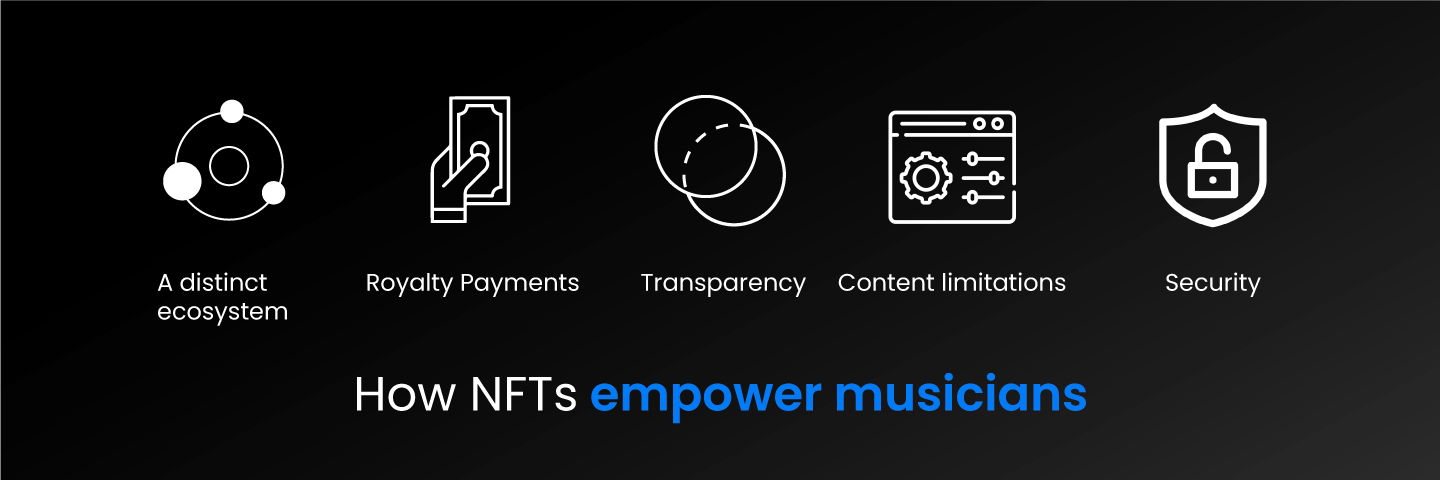
A distinct ecosystem
As a result of blockchain technology’s ability to record data, its monitoring is now simpler than ever. This enables musicians to develop their independence and concentrate on their creativity. A distributed database for storing data urges music companies to modify their business models and transfer their focus to creators.
Royalty Payments
Original creators are frequently at a disadvantage when it comes to obtaining royalties. The traditional method for dividing a song’s earnings among its producers, publishing houses, and artists was to divide the amount among those parties. As a result, artists did not receive equitable compensation the majority of the time. NFTs have facilitated a fair distribution of royalties in the music industry.
Transparency
As is common knowledge, NFTs are facilitated by blockchain, the most reliable and open technology developed in recent years. NFTs based on the blockchain facilitate the seamless association of an original musical file with its various proprietors. Additionally, keeping track of viewership and utilization of content created for multiple platforms has become more effective.
Content limitations
Embedding them grants full ownership to composers and musicians, allowing them to keep track of the number of times any particular NFT has changed hands, in addition to the current and previous owners. Consequently, the likelihood of hacking and copyright violations is minimal. This is a result of peer-to-peer distribution of content.
Security
Smart contracts are employed to regulate the distribution of payments among rights holders. They are electronic contracts, which are one of the most interesting innovations in the blockchain industry. Smart contracts eliminate the need for third-party intermediaries, making the entire automated system more efficient and economical.
Conclusion
The rising number of blockchain-based applications, such as NFTs, has caught the interest of numerous significant corporations. NFTs offer intriguing possibilities for the music industry and numerous advantages for artists and music fans. By eliminating the need for middlemen, music NFTs enable greater compensation for artists. Additionally, they build sturdier and more interconnected groups. Fans also experience a great benefit, as they can communicate directly with their favorite musicians. NFTs in music and the development of the music NFT marketplace may be considered significant contributors to the expansion of the music industry. There is no doubt that NFTs will give power to artists and followers in the future.