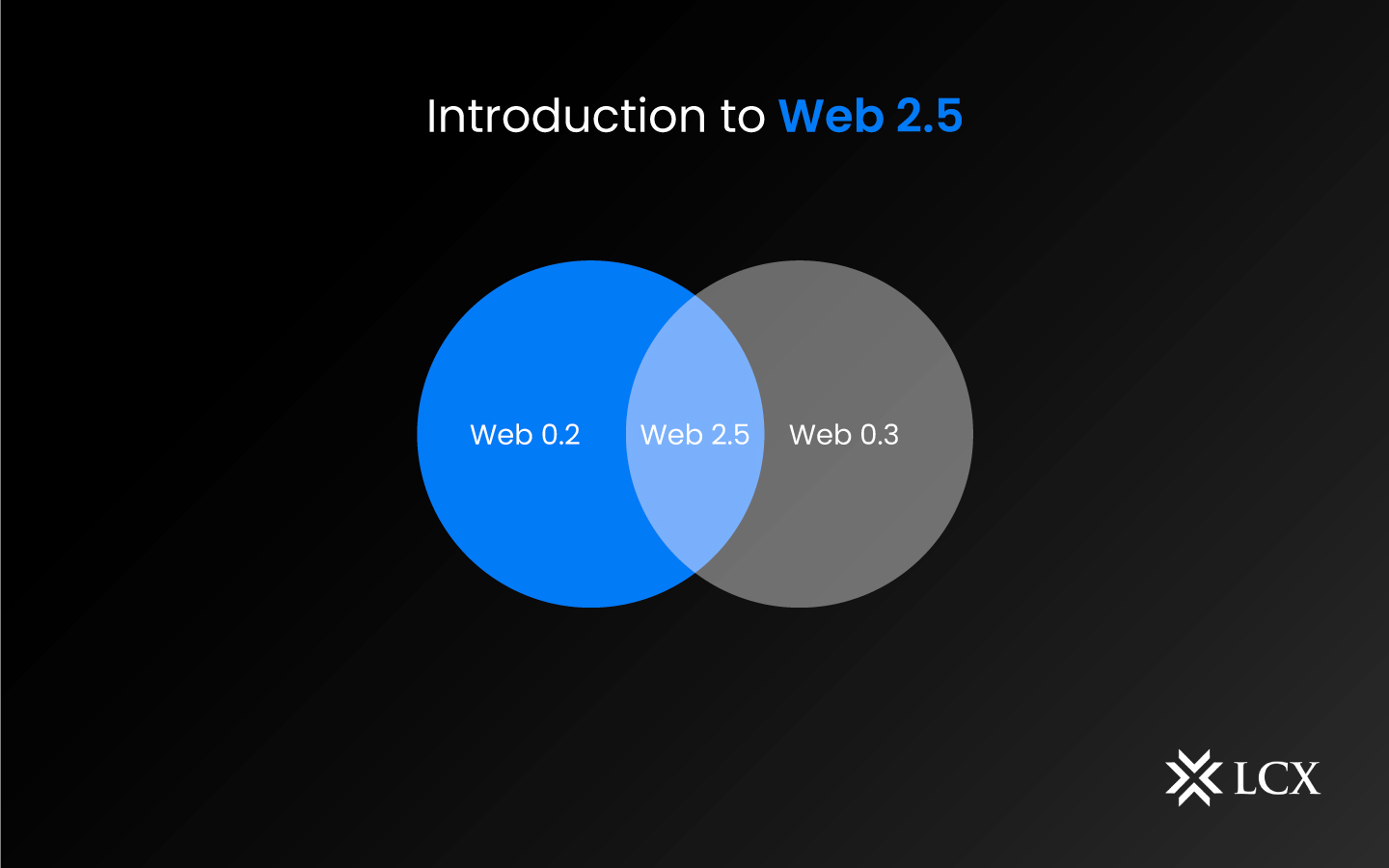
Introduction to Web 2.5
av LCX Team ·
Since its inception, the Internet has transformed from a static, unidirectional communication medium into a dynamic and interactive platform. The transition from Web 1.0 to Web 2.0 paved the way for a new era of user-generated content, social media, and individualized experiences. However, with the adoption of Web 3.0, the next stage in the evolution of the Internet, we confront new challenges and opportunities. Thus, Web 2.5 has emerged as a system that bridges the divide between Web 2.0 and Web 3.0, which is based on blockchain technology.
Thus, Web 2.5 has emerged as a system that bridges the divide between Web 2.0 and Web 3.0, which is based on blockchain technology. It is a bridge between the legacy web and blockchain, combining the best aspects of old web technology with the revolutionary potential of blockchain. It functions as an extension of Web 2.0 that facilitates interoperability between various blockchain networks and conventional systems, resulting in a more integrated and efficient environment.
What Is Web 2.5?
Web 2.5 is essentially the convergence of Web 2.0 and Web 3.0 technologies, the integration of blockchain technology into the existing Web 2.0 infrastructure in order to create new use cases and opportunities. It aims to make blockchain technology more accessible and user-friendly for mainstream consumers by increasing its accessibility and usability. The essence of Web 2.5 is interoperability. It enables communication between legacy web applications and blockchain-based applications, resulting in a more seamless user experience. This technology enables the tokenization of assets and the development of decentralized financial (DeFi) applications, such as non-fungible tokens (NFTs) and proof-of-stake (PoS) networks.
Web 2.5 is indispensable for interoperability because it facilitates the transfer of data and assets between blockchains and conventional systems. Interoperability is necessary for the widespread adoption of blockchain technology because it enables disparate systems to communicate and interact with one another, resulting in a more connected and efficient ecosystem. It achieves interoperability by creating cross-chain solutions that enable the transmission of data and assets between blockchains. Cross-chain solutions enable users to transmit assets between blockchain networks, creating new decentralized exchange, liquidity, and asset management opportunities.
What Distinguishes Web 2.5 From Web 2?
Web 2.5 is distinguished from Web 2.0 by the addition of new capabilities and applications facilitated by blockchain technology to the Web 2 infrastructure. Web 2.0 was defined by the proliferation of social media, cloud computing, and mobile devices, heralding a new era of interactive and user-generated content. It expands on existing infrastructure by utilizing blockchain technology to create new decentralization, transparency, and security opportunities.
One of the primary differences between Web 2 and Web 2.5 is the ability to tokenize assets. Tokenization is the process of converting physical assets, such as real estate or securities, into blockchain-based digital tokens. This creates new ownership and investment opportunities because tokens can be fractionalized and traded on decentralized exchanges without the need for intermediaries such as banks or brokers.
Web 2.5 expands on Web 2 by enabling the development of applications for decentralized finance (DeFi). DeFi programs offer peer-to-peer lending, borrowing, and trading without intermediaries, thereby expanding options for financial inclusion and democratizing access to financial services. In addition to enabling the development of decentralized social media and cloud storage platforms, it expands on Web 2 in another manner. Comparatively, compared to centrally managed systems, which are susceptible to data breaches and censorship, decentralized social media and cloud storage services offer superior privacy and control over personal data.
What Are the Advantages of Web 2.5?
Web 2.5 has numerous advantages, including the ability to bridge the gap between the existing Web 2.0 infrastructure and the developing blockchain-based Web 3.0 technology. Some of the advantages of Web 2.5 are as follows:
- Increased Accessibility: It applications make it simpler for the general public to interact with blockchain-based decentralized applications (dApps) and gain access to them. This is achieved through the enhancement of user interfaces and the integration of existing banking systems.
- Asset Tokenization: It’s applications permit the tokenization of assets, which introduces new forms of ownership and investment. Tokenization also enables fractional ownership of assets that were previously inaccessible to the average investor.
- Decentralized Finance: It’s applications enable the creation of decentralized finance (DeFi) applications that facilitate peer-to-peer lending, borrowing, and trading without intermediaries such as banks. This increases the likelihood of financial inclusion and democratizes access to financial services.
- Interoperability: Web 2.5 applications facilitate the interoperability of diverse blockchain networks and protocols. This enables users to transfer assets and data between blockchains, which opens the door to new use cases and innovation opportunities.
- Decentralized Social Media: Web 2.5 applications enable the creation of decentralized social media platforms, which offer improved privacy and control over personal data. Additionally, decentralized social media creates new opportunities for content monetization and ownership.
- Decentralized Cloud Storage: Web 2.5 applications enable the creation of decentralized cloud storage platforms, which offer superior security and privacy than centralized cloud storage providers.
- Supply Chain Management: Compared to centralized supply chain management systems, Web 2.5 applications enable the creation of decentralized supply chain management systems, which offer greater transparency and accountability.
- Decentralized Gaming Platforms: Web 2.5 applications facilitate the development of decentralized gaming platforms, which creates new opportunities for in-game monetization and ownership.
What Can We Look Forward To?
The incorporation of blockchain technology into conventional web infrastructure drives innovation and creates new opportunities for decentralization, security, and transparency, which bodes well for Web 2.5’s near future. The continuous growth of DeFi applications is one of the most important predictions for Web 2.5. As more users become aware of the benefits of decentralized finance, demand for DeFi applications is likely to increase, encouraging innovation and creating new potential for financial inclusion and democratizing access to financial services.
Another huge Web 2.5 prediction is the expansion of NFTs and the tokenization of assets. NFTs have emerged as a new form of digital asset ownership, and their use has already expanded beyond art and collectibles, paving the way for the tokenization of real-world assets like real estate, stocks, and commodities.
In addition, Web 2.5 will see a rise in the creation of decentralized social media and cloud storage solutions. These platforms provide greater privacy and control over personal data than centralized platforms, and their prevalence is expected to increase as users become more aware of the risks associated with centralized platforms.
Conclusion
Web 2.5 is the next evolution of the internet, bridging the distance between Web 2.0 and Web 3.0 through the use of blockchain technology. Combining the best features of traditional web technologies with the revolutionary potential of blockchain, Web 2.5 is poised to generate new opportunities for innovation and development across a variety of industries. Web 2.5 enables interoperability between blockchain networks and traditional systems, resulting in a more interconnected and effective ecosystem.