


State hackers drive 420% surge in onchain malware, Chainalysis finds

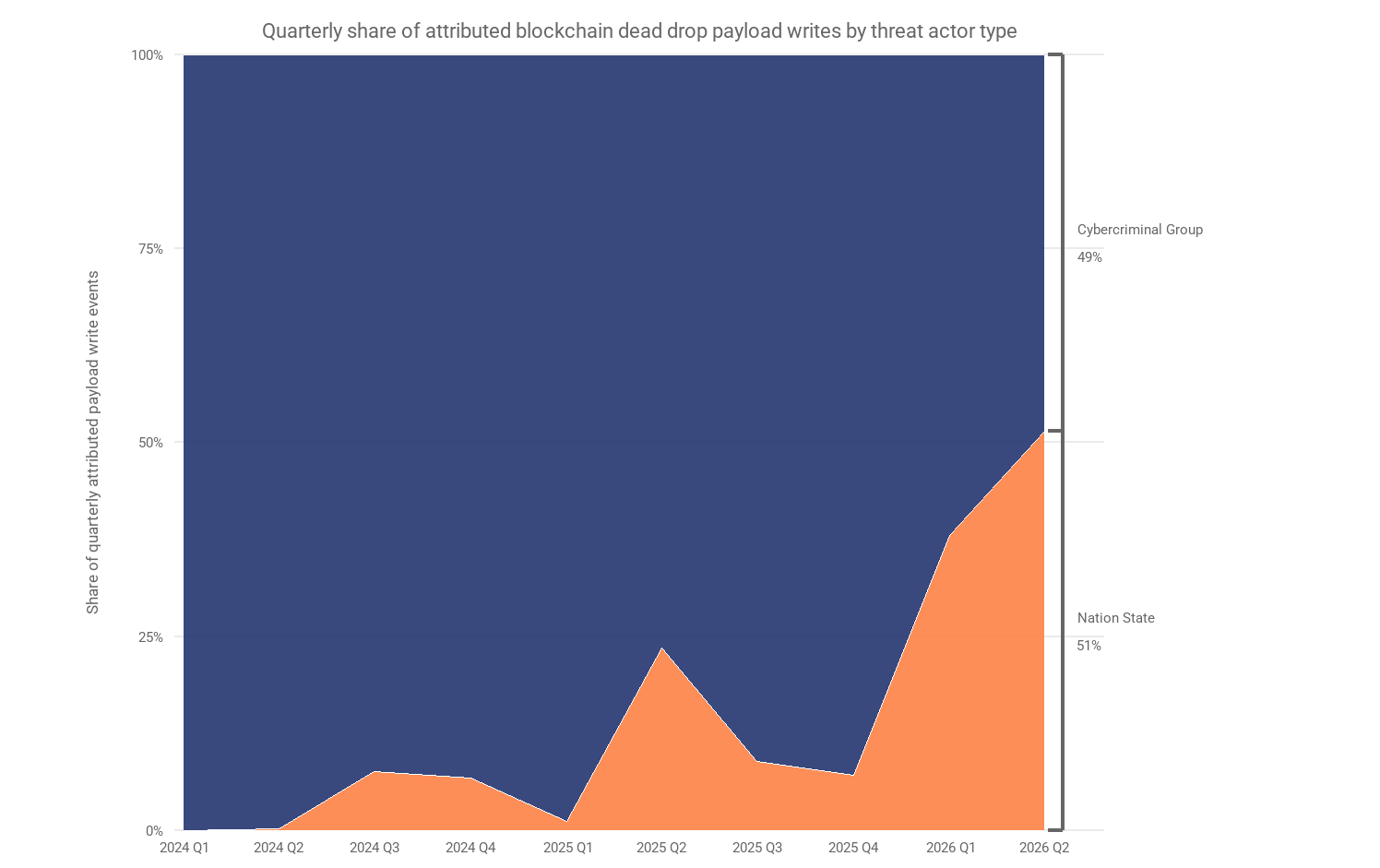
State-linked hackers accounted for roughly two-thirds of new activity each quarter as the number of times attackers stored malware instructions or infrastructure information on public blockchains rose 420% over the past 12 months, according to a Chainalysis report.
Chainalysis identified North Korea and Iran-linked operators among the state actors adopting the technique. In one of the report’s findings, the analytics firm connected previously unattributed activity spanning Tron, Aptos and BNB Smart Chain (BSC) to UNC5342, a North Korea-linked group tracked by Google Threat Intelligence.
Encoded pointers in Tron and Aptos transactions directed infected devices to the same BSC transaction, with Tron serving as the first route and Aptos as a fallback, Chainalysis reported. The BSC transaction contained encrypted server addresses and configuration data that connected compromised devices to offchain infrastructure used for remote access and data theft.
Chainalysis said using public blockchains increases the durability of malware campaigns because the stored information remains accessible after domains, servers or code repositories are taken down. In 2025, North Korean hackers used a similar technique called EtherHiding to place crypto-stealing code in smart contracts.
AI tools accelerate malicious writes
The company also recorded a 440% increase in malicious blockchain writes since July 2025, when it said high-capacity open-source Chinese artificial intelligence models became capable of producing malicious code with limited safeguards.
Eric Jardine, cybercrimes research lead at Chainalysis, told Cointelegraph that they found a “clear point-in-time association,” but could not prove that the actors publishing the malicious transactions and contracts had used the models to increase their output.
Related: Iran eases currency rules to bypass US sanctions with crypto: Report
Iran-linked actors put malware directions on Bitcoin
Chainalysis also identified threat actors it suspects are linked to Iran’s Ministry of Intelligence writing encoded command-and-control routing data onto the Bitcoin blockchain.
The company said its assessment was based on the malware family, decoding method, timing and server infrastructure associated with previously reported Iranian operations, rather than the blockchain activity alone.
Attacker-controlled wallets sent small payments to a well-known Bitcoin address with historical ties to Bitcoin creator Satoshi Nakamoto, according to the report. Chainalysis said the address had no connection to the attackers and served as a permanent public location that infected devices could check for updated directions.
The attackers could change their server infrastructure by publishing another Bitcoin transaction, after which infected devices would automatically retrieve the new information. Once the malware obtained those instructions, the operation moved offchain for activities that could include remote access, credential theft and the delivery of additional malware.
Magazine: Revolut ID thefts highlight KYC’s dangers: Here’s how to fix it
Cointelegraph is committed to independent, transparent journalism. This news article is produced in accordance with Cointelegraph’s Editorial Policy and aims to provide accurate and timely information. Readers are encouraged to verify information independently.